

India’s Solar Boom Is Reshaping the Grid: Why Storage and Infrastructure Matter Now
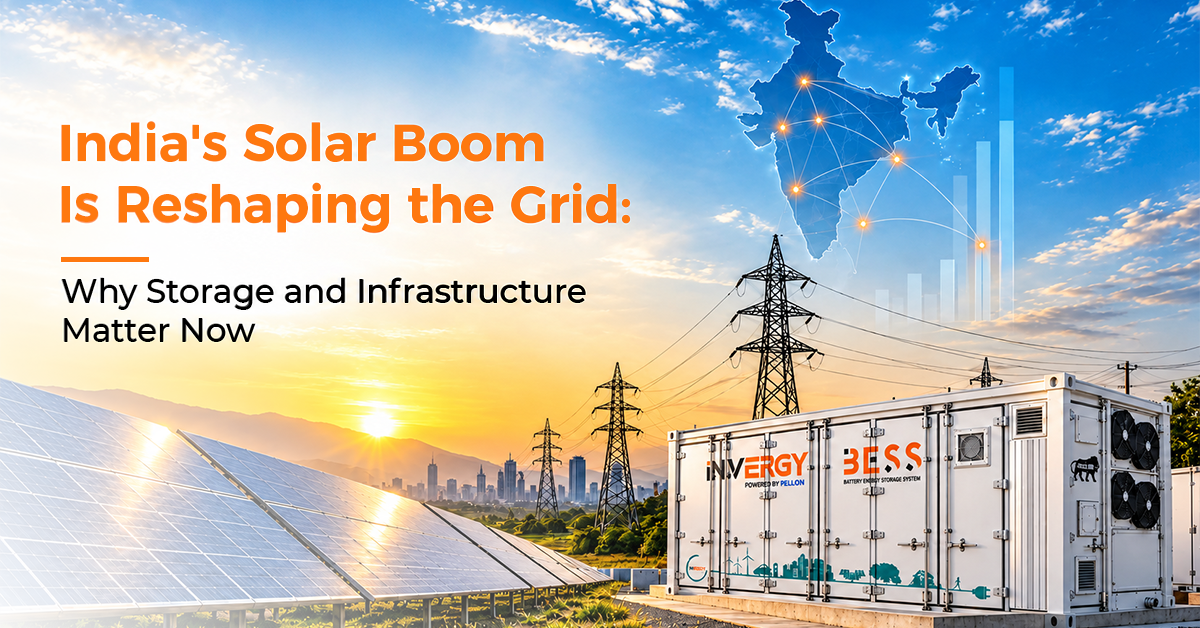
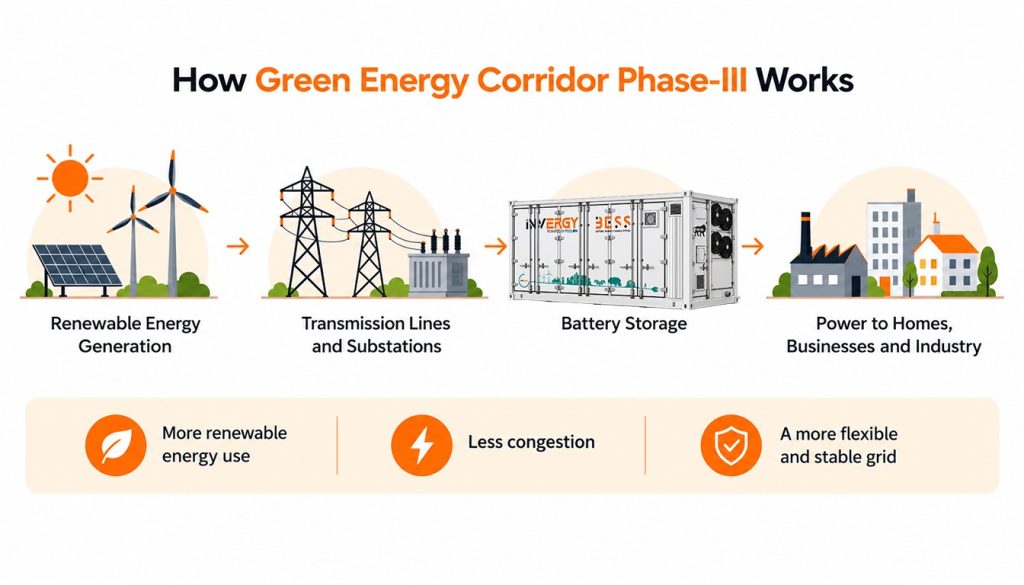
The Union Cabinet has approved Green Energy Corridor Phase-III. The scheme carries a total outlay of ₹1,86,405 crore and is meant to move up to 135 GW of renewable power across state grids by FY 2032-33. Most of it, ₹1,36,378 crore, builds intra-state transmission lines and substations. The remaining ₹50,000 crore pays for something transmission on its own cannot deliver: 50 GWh of battery energy storage.
Additionally, the central government has sanctioned ₹54,082 crore in Central Financial Support to help offset intra-state transmission costs and ease the impact of electricity costs on consumers.
That second allocation is the one worth reading twice, because it marks a change in what the grid is being asked to solve.
What is a green energy corridor?
Green Energy Corridor (GEC) is a government initiative to strengthen India’s power grid so electricity from renewable sources, such as solar and wind, can reach more regions. It does this by expanding transmission lines and substations. Phase-III adds large-scale battery storage to help manage fluctuations in renewable generation and make more power available when demand rises.
The constraint has moved from capacity to timing
Solar output peaks around midday and falls away at sunset, while demand across most of India climbs through the evening. The result is a grid that can be comfortable at noon and tight at eight o’clock on the same day.
The Economic Advisory Council to the Prime Minister (EAC-PM) highlighted this challenge in its July 2026 working paper, The Duck and The Camel: Tracing the Net Load on the Indian Power Grid. Across April and May 2026, the grid fell short of demand at the non-solar-hour peak on 36 of 61 days, compared with just 6 days at the solar-hour peak.
This mismatch makes storage and grid flexibility increasingly important. Battery storage can retain surplus electricity and release it during high-demand periods, while stronger transmission infrastructure helps move power to where it is needed.
The scale of India’s electricity demand adds to the challenge. On 25 April 2026, demand reached a record 256.1 GW. Meeting peaks like this requires not just enough generation capacity, but also infrastructure that can deliver electricity when and where it is needed.
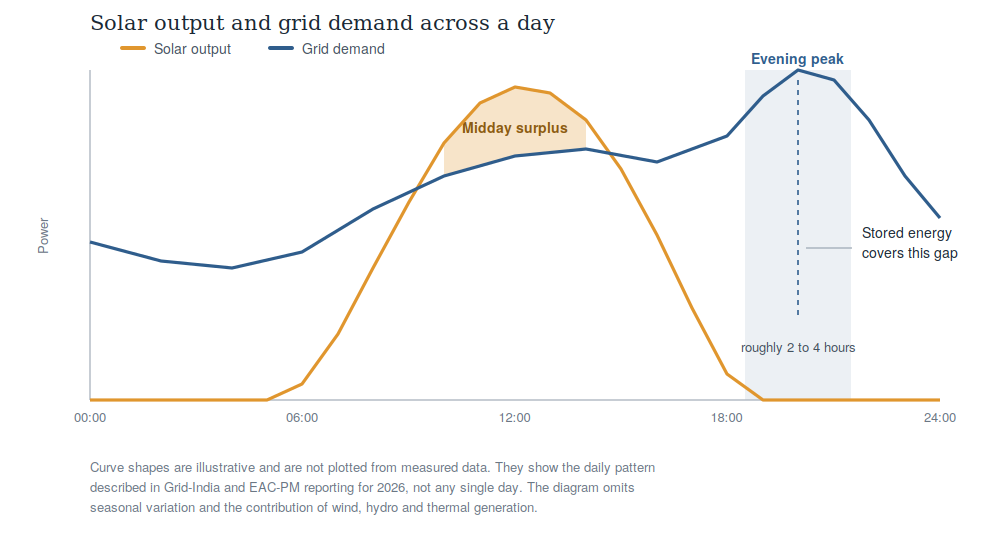
When midday generation exceeds what the local network can absorb or carry away, operators curtail it. The plant is instructed to stop producing electricity, and nobody pays for power that was never generated. Curtailment is the visible cost of a system that can produce renewable electricity but cannot hold on to it.
Why GEC-III puts the batteries at the generator end
The scheme places its 50 GWh of storage at the renewable developer or generator end, or at other locations selected for grid flexibility. The stated purpose is to address intermittency, congestion, peak-hour curtailment, and non-solar-hour demand.
Siting matters more than it sounds. Storage next to generation absorbs surplus before it reaches a congested line, so the same transmission asset carries more useful energy across a day. It also changes the job of the power electronics connected to it.
What that asks of a storage system
A grid-tied inverter on a solar-only plant spends most of its life doing one thing: converting DC to AC and exporting. Add storage and the site has to decide, continuously, whether incoming generation goes to the load, to the battery, or to the grid. It also has to decide when to discharge. That logic sits in the inverter and the control layer around it, which is why the checks that matter when choosing a solar inverter change once a battery is part of the design.
The evening peak the scheme is aimed at runs for roughly two to four hours. That number sets most of the specification. A system sized to cover it has to hold its output for that long, return most of what it stored, and do so at Indian ambient temperatures. The table below shows what that looks like on a real datasheet, using Invergy’s utility system as the example.
| What the evening peak demands | What to check on the datasheet | INV BESS 5MWh |
| Output held across the peak | Discharge duration at rated power, and the C-rate it assumes | 2 to 4 hours, at 0.25C to 0.5C maximum |
| Energy you can actually use | Usable energy after depth of discharge, not the rated figure | 4,514 kWh usable of 5,015 kWh rated, at 90% depth of discharge |
| Low losses on the round trip | Round-trip efficiency, since every stored unit loses something | 85% |
| Stable behaviour in Indian conditions | Cooling method and ambient operating range | Liquid cooling, −10°C to 55°C |
| Control by the grid operator | Whether the system can be scheduled and monitored remotely | SCADA-based control over Modbus TCP/IP |
Nameplate capacity answers none of these on its own. Two systems quoted at the same kWh can diverge noticeably across a five-year operating window, and where they diverge usually shows up in the datasheet rather than the brochure. Cell chemistry sits underneath all of it, which is why the difference between LiFePO4 and other lithium-ion chemistries is worth understanding before comparing two quotes.
Where INVERGY fits
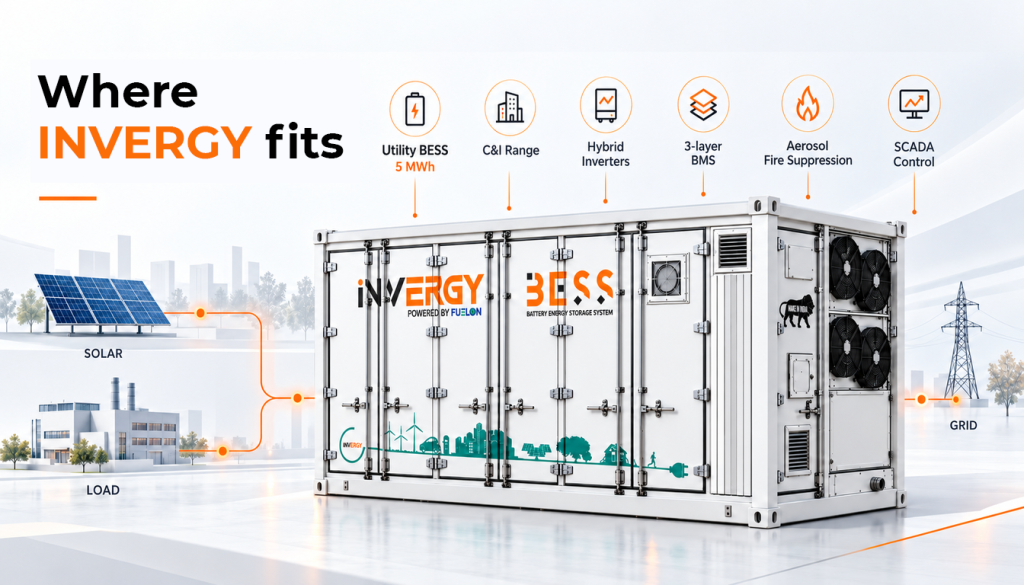
INVERGY‘s utility BESS line is built around a containerised 5 MWh system designed for utility operators and independent power producers, with a three-layer BMS, aerosol fire suppression and SCADA control. The C&I range covers smaller sites, and the hybrid inverter range handles the switching between solar, battery, load and grid that a storage-backed site depends on.
For commercial and industrial buyers, there is a second reason to look at this now. Stored energy now counts as captive consumption under the revised rules, which changes the arithmetic on solar-plus-storage projects that previously only made sense on generation alone.
What this means for the next phase
India’s next stretch of solar growth depends less on how many megawatts go up. It depends more on how much of that generation reaches demand at the hour it is needed. A scheme committing ₹50,000 crore to storage alongside ₹1.36 lakh crore of transmission is a reasonably clear signal about which problem the system now treats as urgent.
For commercial, industrial, and utility-scale projects, that moves storage and inverter specification out of the optional column and into the basic design question.
Planning a solar-plus-storage project?
Send us your load profile and generation data, and our team can walk you through what the system would need to cover, from discharge duration to usable energy at your site conditions.
Talk to the Invergy BESS team or message us at +91 81308 66114.
Invergy