

Solar Plus BESS: Storage Now Counts as Captive Consumption
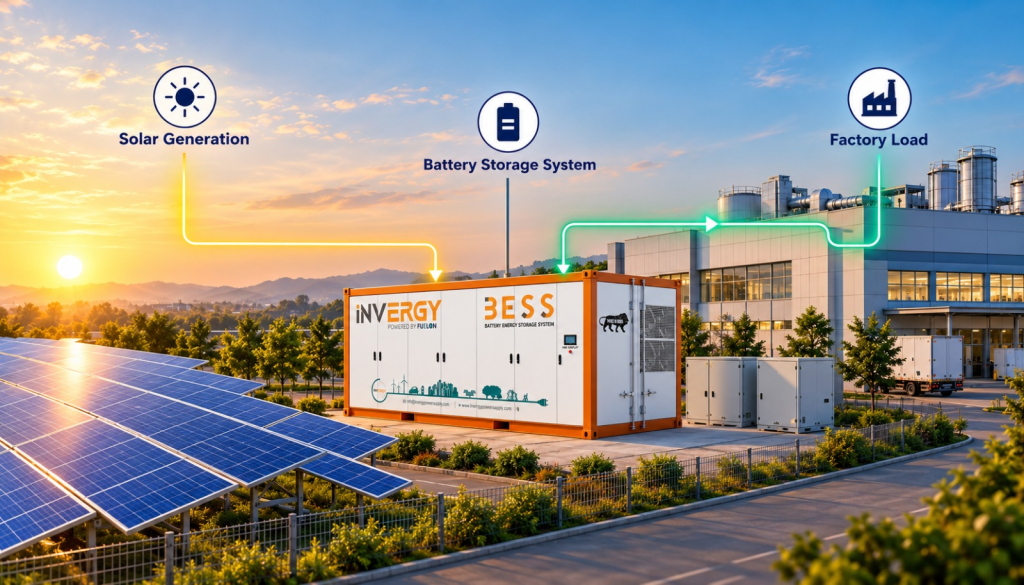
Solar generation and factory demand rarely follow the same schedule. A BESS can store surplus solar during the day and supply it when demand rises later, but does that stored energy still count as captive consumption?
The Electricity (Amendment) Rules, 2026 have clarified this for captive solar projects. This blog explains what changed, which solar plus BESS projects it affects, and how battery charging, metering, and the 51% captive consumption test now apply.
What changed for battery storage in March 2026
Captive power is electricity a business generates mainly for its own use, either on its own site or at a plant it part-owns elsewhere. To keep that status, the users must together hold at least 26% of the plant and consume at least 51% of what it generates in a financial year.
On 13 March 2026, the Ministry of Power notified the Electricity (Amendment) Rules, 2026. They replace Rule 3 of the Electricity Rules, 2005, which sets these tests.
The new definition of a captive user covers anyone who consumes captive electricity directly, or through an energy storage system that stores energy generated by that captive plant. Put simply, solar power that passes through a battery on its way to you still counts as your captive consumption.
A battery energy storage system (BESS) is a bank of batteries with the power electronics and controls to charge and discharge on demand. Our guide to how a battery energy storage system works covers the basics.
The new definitions took effect on the day of notification. Provisions on group consumption shares, verification and surcharges started on 1 April 2026, according to the Ministry of Power’s release.
How Captive Status Affects Open Access Charges and Battery Storage
Captive status matters most when power travels from the plant to the user over the grid, an arrangement called open access. Under the Electricity Act, 2003, the open access surcharge does not apply when a captive plant owner carries power to its own point of use.
That surcharge is the cross-subsidy surcharge (CSS), which funds lower tariffs for other consumer groups. Open access users can also face an additional surcharge (AS), which recovers fixed costs the distribution company still carries. Captive users avoid both.
The penalty for losing captive status is heavy. Under the amended rules, a plant that misses the 51% test has its entire output treated as supply from a generating company. Both surcharges then apply to all of it.
Until this year, Rule 3 said nothing about storage. Energy that went into a battery before reaching the user sat in a grey area, open to challenge by the distribution company. For a project built around evening demand, that doubt put the whole plant’s captive status at risk.
Which solar plus BESS projects this affects
The storage clause matters only where captive status decides whether surcharges apply. That depends on how you receive the power.
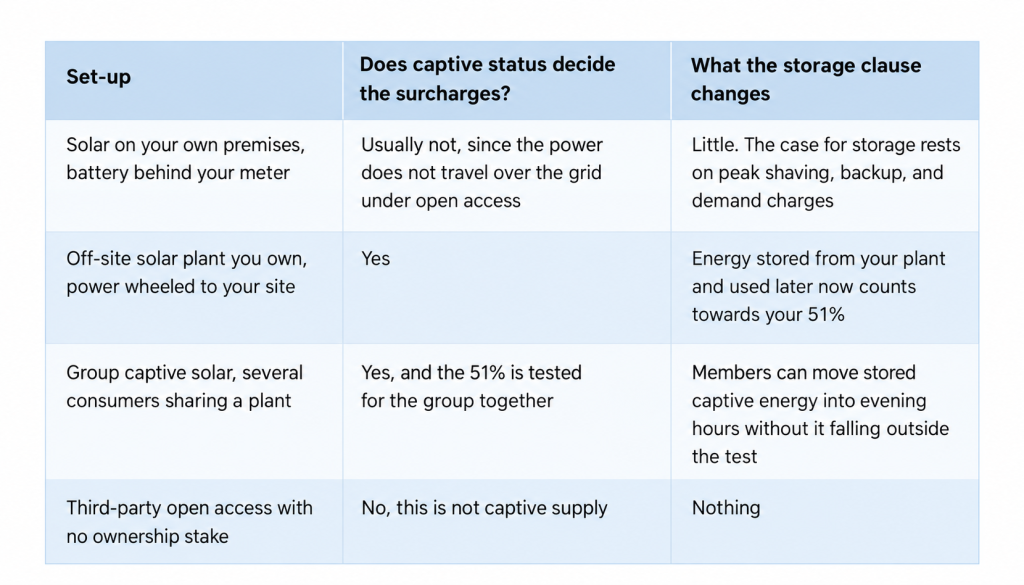
The middle two rows are where the amendment does its work. If you already buy power under open access, our earlier piece on battery storage for open access users covers the tariff and banking side. Banking is the arrangement where surplus is parked with the grid and drawn back later, on terms each state sets.
For a battery behind your own meter, the captive rules rarely come into it. The value there comes from the everyday uses of BESS in commercial and industrial sites.
What Energy Stored in a BESS Counts as Captive Consumption
Most coverage of the amendment stops at “storage now counts”. The definition, as law firms reviewing the notification reproduce it, is narrower. It covers consumption through a storage system “used for storing energy generated from such captive generating plant”.
That wording attaches the benefit to what is inside the battery, not to the battery. Three practical consequences follow.
- Grid-charged energy stays grid power. If a battery tops up from the distribution company overnight, that energy was bought from the grid. Storing it does not turn it into captive generation, so it cannot help the 51% test.
- Mixed charging needs a method. Many sites will charge from solar on clear days and from the grid on cloudy ones. The amendment does not say how to split stored energy by source, and a review by Sagus Legal lists storage accounting, including grid charging, as an open question.
- Battery losses are not addressed. A battery always returns less energy than it takes in. The rules do not say whether captive consumption is counted as energy enters the battery or as it leaves, which matters for a plant running close to 51%.
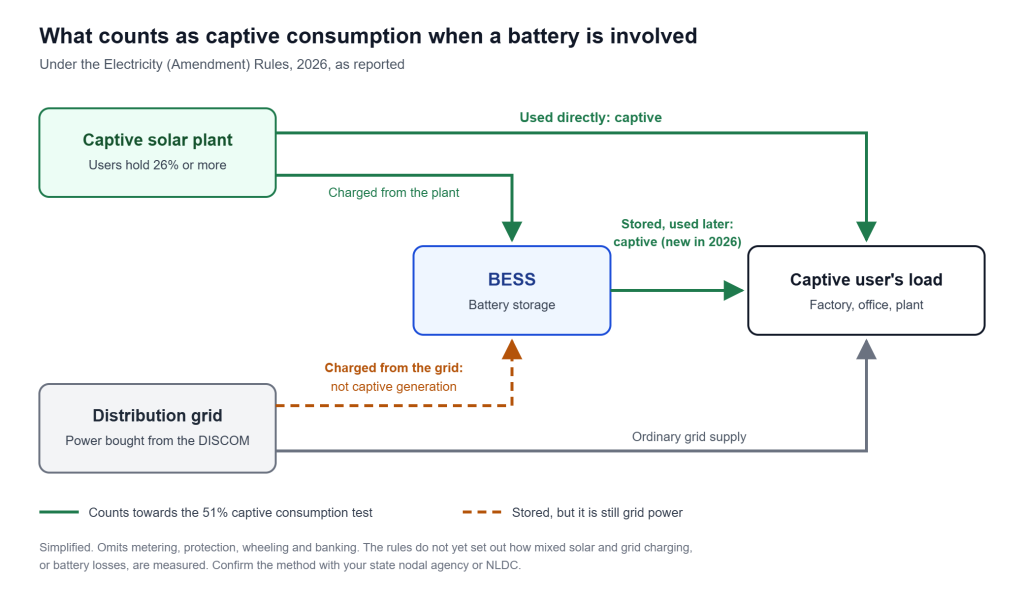
The storage clause turns on where the stored energy came from. How mixed charging and battery losses are measured is still to be settled.
Where the battery sits is a smaller open point. Some summaries describe storage as “connected to” the captive plant. The reported definition links the battery to the source of its energy and does not name a location.
You may plan a battery at your factory, charged with captive power wheeled from the plant. Confirm with your state’s verifying agency that it will be treated like a battery at the plant before the design is frozen.
The practical effect is that a BESS in a captive project stops being only an operating asset. Its charging rules and its records become part of how you prove captive status every year.
What to check before adding BESS to a captive solar project
Verification now runs on a fixed calendar. Captive status is checked for the whole financial year.
A nodal agency named by the state government verifies cases where the plant and its users are in the same state. The National Load Despatch Centre (NLDC) handles cases that cross state lines, and a Grievance Redressal Committee hears disputes.
While verification is pending, CSS and AS are not levied if the captive users file the prescribed declaration. If the plant later fails, both surcharges fall due with carrying cost, calculated at the base rate under the Electricity (Late Payment Surcharge and Related Matters) Rules, 2022. The declaration only defers the charges, so the risk stays with the users until verification is complete.
With that in mind, these are the points to settle early.
- Charging source. Decide whether the battery may charge from the grid at all. If it may, set charging windows in the energy management system (EMS) so solar and grid charging can be told apart.
- Metering points. Meter energy into and out of the battery, as well as plant output and site consumption. Ask your nodal agency which meter data it will accept.
- A full year of records. Keep interval data for charging, discharging, and state of charge across the whole financial year, since that is the verification period.
- Headroom above 51%. A plant close to the threshold has little room for battery losses or grid-charged cycles. Model a full year of generation, storage, and consumption before fixing battery capacity.
- State regulations. Law firms reviewing the rules note that state commissions will need matching changes to their own captive regulations. Check your state regulator’s current position.
- Ownership records. A special purpose vehicle (SPV) that owns the plant is now treated as an association of persons. Shareholding changes during the year need clean records, because consumption shares are worked out on a weighted average basis.
Other 2026 changes that affect solar plus BESS projects
The storage clause arrived alongside wider changes to group captive structures. Several of them shape how a shared battery can be used.
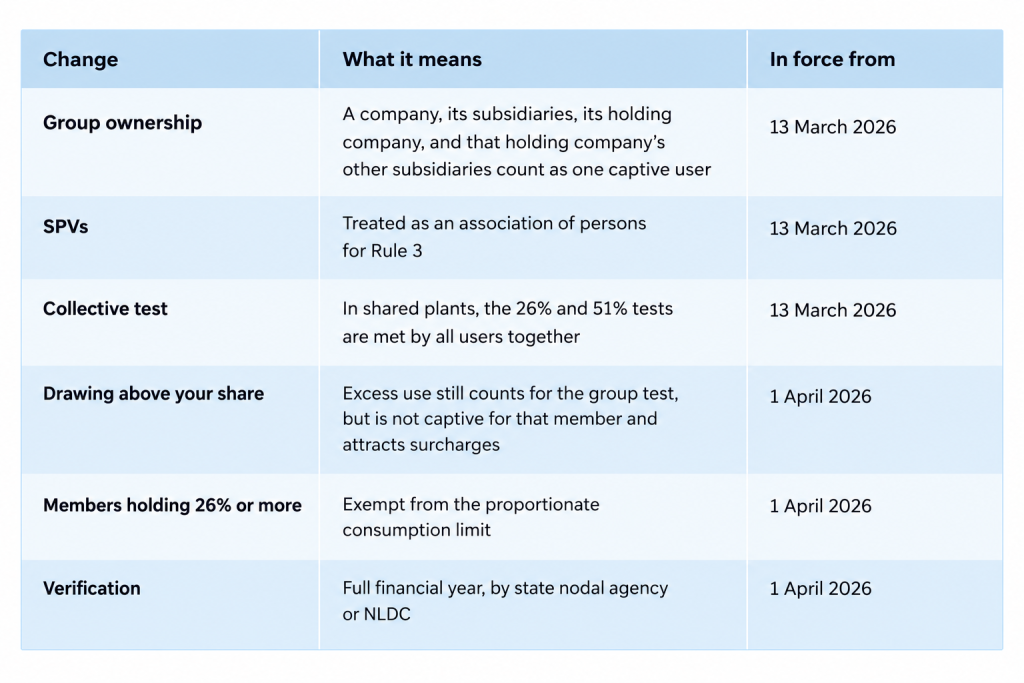
The fourth row matters most for shared storage. If one member draws heavily from a shared battery in the evening, its total use can run past its proportionate share. Check each member’s position against the cap, or against the 26% exemption, before agreeing how stored energy is allocated.
What is still unsettled
The amendment gives storage a clear legal footing, and the working detail is still arriving. Verification will run on procedures issued by NLDC and the state nodal agencies, and those procedures are where storage accounting is most likely to be defined.
State commissions also need to bring their captive regulations in line. Until they do, practice may differ between states, so check the position in the state where your plant sits and the state where you consume.
Treat any storage accounting method you adopt now as provisional, and keep the raw data so it can be recalculated if the rules change.
Where Invergy BESS fits
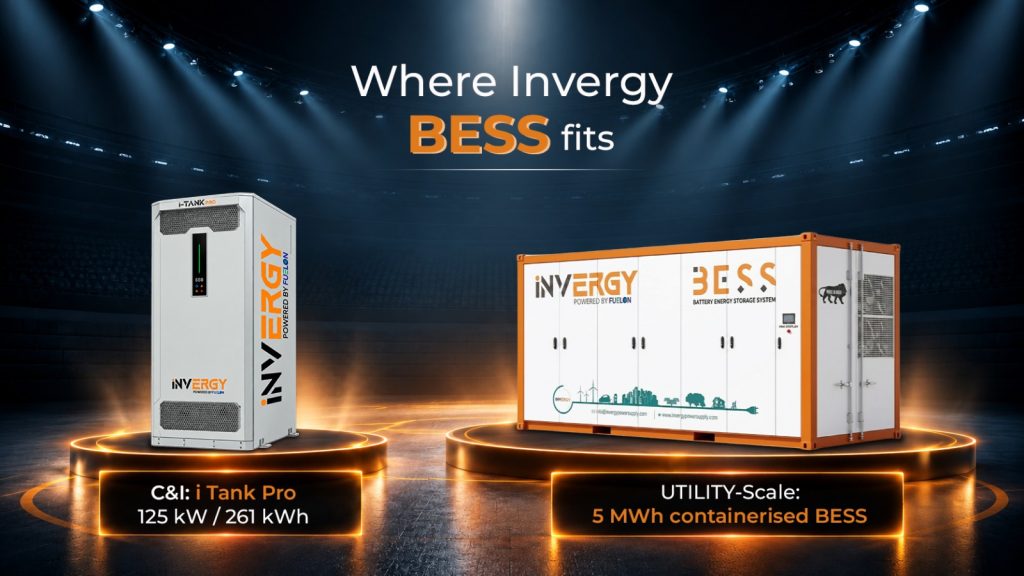
Invergy manufactures solar inverters and energy storage systems for residential, commercial, industrial, and utility segments.
For commercial and industrial sites, the i-Tank Pro C&I BESS is a 125 kW, 261 kWh cabinet built on lithium iron phosphate (LFP) cells. It uses liquid cooling and three-tier fire suppression, and supports grid-tied and standalone operation with EMS-based charge and discharge scheduling.
For utility-scale renewable projects, the utility BESS range is built around a 5 MWh containerised system with SCADA-based control over Modbus TCP/IP.
Charge and discharge scheduling matters under the new rules. When stored energy has to come from the captive plant, the times a battery is allowed to charge are the first thing to plan.
Conclusion
The 2026 amendment removes the doubt that made storage risky in captive solar projects: energy stored from the captive plant stays captive. It leaves open how that energy is measured, which puts the battery’s charging rules and data at the centre of every annual verification.
Before you size a battery, map a full year of plant output, charging and consumption against the 51% line, and agree the metering points with your verifying agency.
Planning solar plus BESS for a captive or group captive project? Talk to an Invergy expert about C&I and utility BESS options for your site.
Frequently asked questions
Does energy from a battery count as captive consumption?
Yes, where the battery stores energy generated by the captive plant. The Electricity (Amendment) Rules, 2026 define a captive user to include consumption through such a storage system. Energy the battery takes from the grid is ordinary grid supply.
When did the storage provision take effect?
The amended definitions, including the one covering storage, took effect when the rules were notified on 13 March 2026. The verification, group consumption and surcharge provisions applied from 1 April 2026.
Does rooftop solar with a battery need captive status?
Usually not for surcharge purposes. Cross-subsidy surcharge applies to power supplied under open access, so captive status matters most where power travels over the grid from a plant you own or co-own.
Can a captive BESS be charged from the grid?
The amendment does not deal with grid charging directly. Grid-charged energy is not captive generation, so it cannot count towards the 51% test. If a battery charges from both sources, meter it so the two can be separated.
Who verifies captive status now?
A nodal agency designated by the state government verifies plants whose users are in the same state. The National Load Despatch Centre verifies cases that cross state lines. Verification covers the full financial year.
What happens if a captive plant fails the 51% test?
All electricity from the plant is treated as supply by a generating company, and cross-subsidy and additional surcharges apply to all of it. If a declaration was filed while verification was pending, the surcharges become payable with carrying cost.
Invergy