

LiFePO4 vs Lithium-Ion: Advantages and Lifespan
Search “LiFePO4 vs lithium-ion,” and most results compare the two as separate products. One is said to last ten years, the other two or three, as if they belonged to entirely different families. That framing causes more confusion than it clears up.
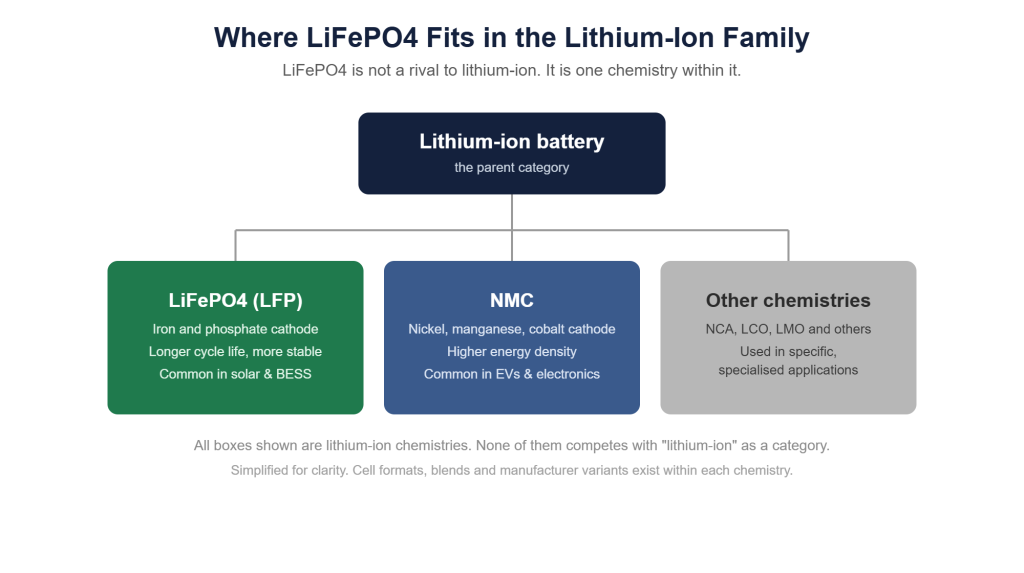
LiFePO4 is a lithium-ion battery. It is a specific, safer chemistry within the lithium-ion family, not a competitor to it. The comparison is really between LiFePO4 and the other lithium-ion chemistry commonly used in similarly sized batteries.
So what really separates LiFePO4 from other lithium-ion batteries, and why does it last so much longer in a solar system?
Is LiFePO4 a type of lithium-ion battery, or something different?
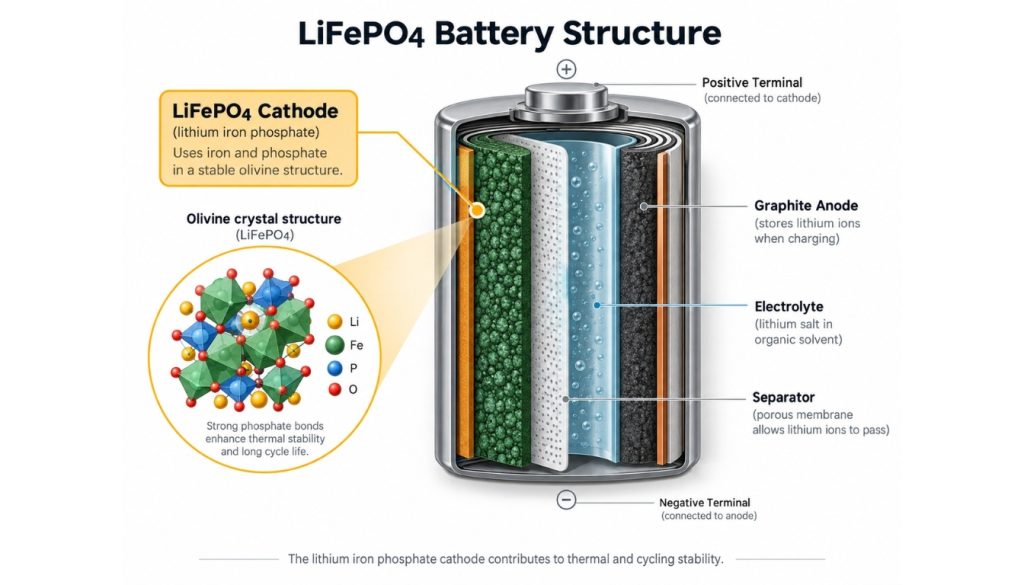
Every lithium-ion battery works the same basic way. Lithium ions move between a negative electrode and a positive electrode, called the cathode, to store and release energy. What changes between “types” of lithium-ion battery is mostly the material used in that cathode.
LiFePO4 (lithium iron phosphate) uses iron and phosphate in its cathode. NMC (nickel, manganese, cobalt), the other lithium-ion chemistry most people actually mean when they say “lithium-ion” without specifying, uses those three metals instead.
Both are lithium-ion batteries. The comparison that matters for a solar buyer is LiFePO4 against NMC, not LiFePO4 against “lithium-ion” as a whole category.
What is LiFePO4, in plain terms?
LiFePO4’s cathode has a crystal structure called olivine, which holds its oxygen atoms tightly bound within the structure. That tight bond is why LiFePO4 resists thermal runaway, a chain reaction inside a battery where rising heat causes further heat. It is the main safety failure mode in any lithium battery.
NMC’s cathode has a looser, layered structure that can release oxygen at high temperatures, feeding a fire once one starts. Independent laboratory testing puts LiFePO4’s thermal runaway onset meaningfully higher than NMC’s, generally above 200°C for LiFePO4 against a lower and more variable threshold for NMC. Exact figures shift with cell size and test method, so treat any single number you see online as an approximation rather than a fixed spec.
Large-format lithium batteries built for stationary use, including both LiFePO4 and NMC packs, are tested against IEC 62619, the international safety standard for industrial and stationary lithium batteries. A supplier who can point to testing against a named standard is giving you something checkable, unlike a bare safety claim.
How does LiFePO4 compare with other lithium-ion batteries like NMC?
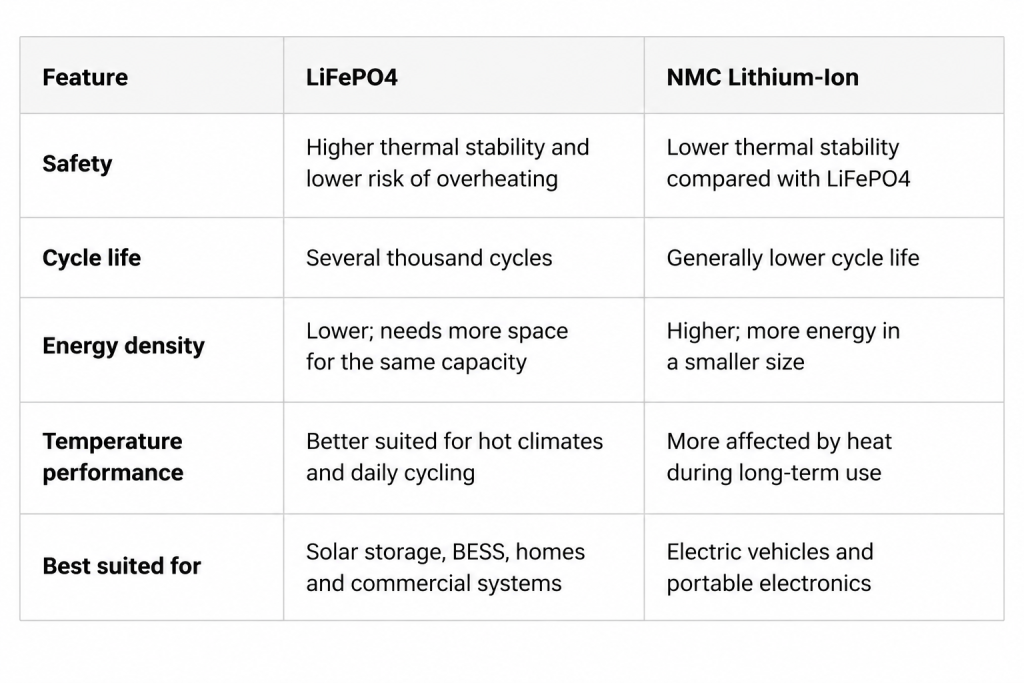
NMC packs more energy into less weight, which is why it dominates electric vehicles and phones, where every kilogram and litre counts. LiFePO4 is heavier and bulkier for the same stored energy, a real trade off and not a marketing footnote.
For a stationary solar battery, weight and size matter far less than they do in a car or a phone. What matters more is cycle life, safety, and how the battery behaves after years of daily charging through a hot Indian summer. That is where LiFePO4’s stability pays off.
- Cycle life. LiFePO4 batteries are commonly rated for several thousand cycles at 80% depth of discharge, well beyond typical NMC ratings at the same discharge depth. iNVERGY’s own residential LiFePO4 battery, for example, is rated for up to 6,000 cycles at 80% DoD.
- Temperature tolerance. LiFePO4 handles heat better across repeated cycling, which matters directly for rooftop installations exposed to Indian summer temperatures. NMC’s layered structure degrades faster under sustained heat.
- Energy density. NMC stores more energy per kilogram, which is why it wins in EVs and consumer electronics. That advantage matters far less once the battery is sitting in a fixed spot at home or on a rooftop.
Why does LiFePO4 last longer?
Every full charge-discharge cycle stresses a battery’s cathode slightly, and how much stress it absorbs before degrading determines cycle life. LiFePO4’s rigid olivine structure resists this stress better than NMC’s layered structure. That is the chemical reason behind the cycle-life gap, not just a manufacturer’s claim.
The quality of the BMS, or battery management system the electronics that monitor and protect individual cells, matters too, whichever chemistry is inside. A cell rated for several thousand cycles in a lab still needs accurate cell balancing and temperature protection in the field to actually reach that number. A published cycle-life figure is only as trustworthy as the BMS behind it.
This is also why most Indian BESS and solar-battery manufacturers, Invergy included, build primarily on LiFePO4 for stationary storage instead of NMC. NMC still leads in electric vehicles and portable electronics, where its higher energy density earns its keep despite the shorter cycle life.
What does this mean for a home or business solar battery?
A battery that charges and discharges daily for years, sitting in a fixed location, does not need to worry much about weight and size. That is exactly where LiFePO4’s advantages line up with what a solar battery needs.
That is a large part of why it has become close to a default choice for stationary solar storage in India. This holds for homes and for commercial and industrial sites alike. Daily cycling and long duty cycles make cycle life the deciding factor more often than upfront price.
If you are comparing quotes, ask the supplier directly which lithium chemistry, LiFePO4 or NMC, sits inside the battery. “Lithium battery” alone does not tell you which one you are buying. The chemistry, not the brand printed on the case, is what determines the lifespan and safety profile you are actually paying for.
Is LiFePO4 pulling further ahead of NMC?
LiFePO4 cell manufacturing has scaled up significantly in India over the past couple of years, narrowing its price gap with NMC and with lead-acid alike. Expect LiFePO4 to keep extending its lead in stationary storage specifically, even as NMC keeps its advantage in weight-sensitive applications such as vehicles.
Conclusion
LiFePO4 is not a rival to lithium-ion. It is the lithium-ion chemistry built for exactly the job a solar battery does: cycling daily, sitting still, and lasting years without drama. The chemistry inside the case matters more than the label on it.
iNVERGY‘s residential LiFePO4 batteries and its Battery Energy Storage Systems for commercial, industrial, and utility applications are both built on this chemistry. Have a look at the LiFePO4 battery range or the BESS options to see the specifications directly.
Frequently asked questions
Is LiFePO4 more expensive than regular lithium-ion?
It can cost slightly more per kilogram of storage than NMC, though the gap has narrowed as manufacturing has scaled up. Over the life of a solar battery, LiFePO4’s longer cycle life usually offsets any higher upfront cost.
Does LiFePO4 lose capacity faster in hot climates?
LiFePO4 handles heat better than NMC, though extreme, sustained heat still accelerates ageing in any lithium chemistry. Keeping the battery out of direct, prolonged sun exposure extends its life regardless of chemistry.
Can I tell which lithium chemistry is in my battery just by looking at it?
No. The datasheet or the cell markings are the only reliable way to confirm the chemistry. A reputable supplier should state it plainly instead of just saying “lithium.”
Is LiFePO4 the same as a lithium-polymer battery?
No. Lithium-polymer refers to the physical cell format and packaging, while LiFePO4 refers to the cathode chemistry inside. A battery can be lithium-polymer in format and use various chemistries inside, LiFePO4 among them.
Does a higher cycle-life rating always mean a better battery?
Not on its own. The rating only holds if it was tested at a stated depth of discharge and backed by a BMS that actually protects the cells in daily use. It is worth asking how the number was tested, not just what it is.
Why don’t electric vehicles all use LiFePO4 if it’s safer?
Weight and range matter more in a vehicle than in a stationary battery, and NMC’s higher energy density gives more range for the same weight. Some manufacturers do use LiFePO4 in shorter-range models, where the safety and cost advantages outweigh the range trade-off.

Invergy