

How Many Batteries Do I Need for Solar? (Sizing Guide)
A homeowner asks a dealer how many batteries their new solar system needs. The dealer says two, but another installer looks at the same rooftop and says four.
Weird, right? But both could be correct. They’re just answering different questions. One’s sizing for a few hours of backup during a power cut. The other’s sizing to run the whole house off stored solar power, every single evening.
That gap between two batteries and four batteries comes down to three numbers most people never actually see written down. Those three numbers are your daily energy use, the number of days of backup you need without sunshine, and the percentage of battery capacity you can safely use before recharging. Get those three numbers right, and the battery count basically works itself out.
At Invergy, that’s the exact math our team runs through with homeowners before brand or price ever comes into the conversation.
What decides the number of batteries
Three inputs decide how many batteries a solar system needs, and none of them require an engineering background to work out.
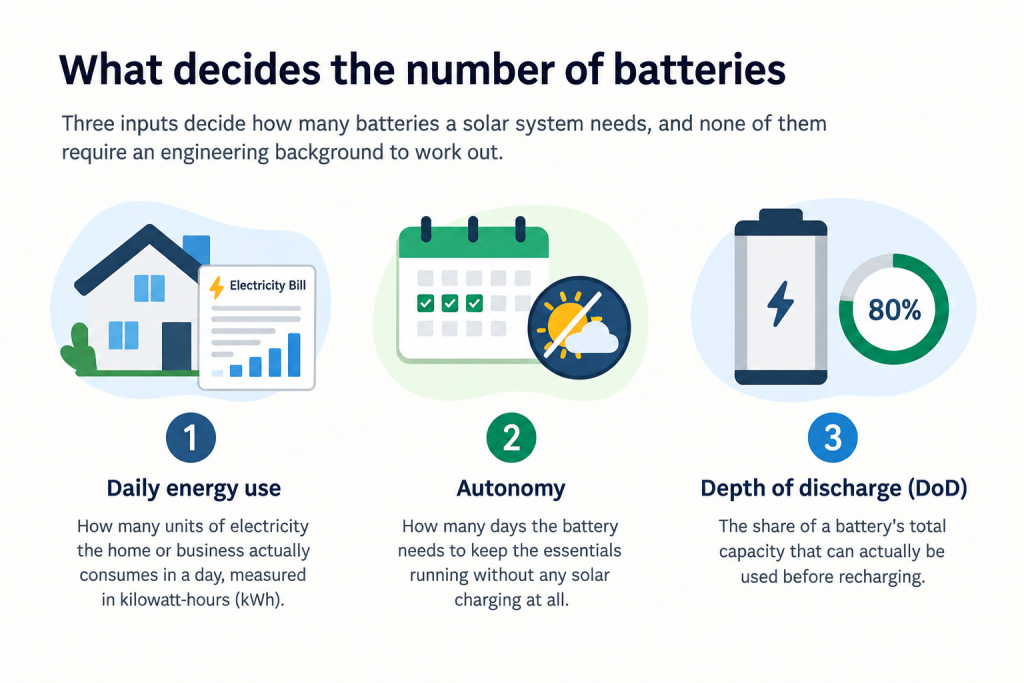
The first is daily energy use: how many units of electricity the home or business actually consumes in a day, measured in kilowatt-hours (kWh). This comes straight off an electricity bill or a simple appliance count.
The second is autonomy: how many days the battery needs to keep the essentials running without any solar charging at all. A backup system for occasional power cuts might need only a few hours. A system built to ride out a cloudy monsoon week needs one to three full days.
The third is depth of discharge, or DoD: the share of a battery’s total capacity that can actually be used before recharging. Multiply the first two together, divide by the third, and the answer is the battery capacity in kWh. The number of physical battery units comes after that, once the kWh figure is settled.
Backup power and daily cycling are different problems
Two batteries can carry the exact same kWh rating and still need to be sized completely differently, because they are solving different problems.
A backup battery mostly sits fully charged and does nothing. It only discharges during a power cut, which in most parts of urban India happens for a few hours at a time, occasionally. Over a year, it might cycle only a handful of times.
Depth of discharge barely matters here, since the battery rarely gets close to its limit. Cycle life barely matters either, since the battery isn’t cycling often enough to wear out on that basis.
A daily-cycling battery is a different animal. It charges from solar surplus every day and discharges every evening, all year round. Here, depth of discharge and cycle life decide almost everything about how long the battery lasts and how much of its rated capacity is genuinely usable. Resources from the U.S. Department of Energy (DOE) and the National Renewable Energy Laboratory (NREL) provide further technical information on battery storage, performance, and renewable energy integration.
This is exactly why the chemistry question, lithium against lead-acid in particular, matters far more for this use case than for pure backup.
The question “how many batteries do I need” only has a stable answer once this distinction is made. A rural home planning for three days without grid power is solving an autonomy problem. A city home trying to run largely on its own solar generation every evening is solving a cycling problem. The formula below is the same in both cases; the inputs that go into it are not.
The formula, worked through
The calculation behind every solar battery sizing tool reduces to one line. That includes the one built into Invergy’s own solar calculator:
Formula:
Required battery capacity (kWh) = Daily energy use (kWh) × Autonomy days ÷ Depth of discharge
The formula gives a kWh target. Getting from that target to an actual order takes two more steps, covered below.
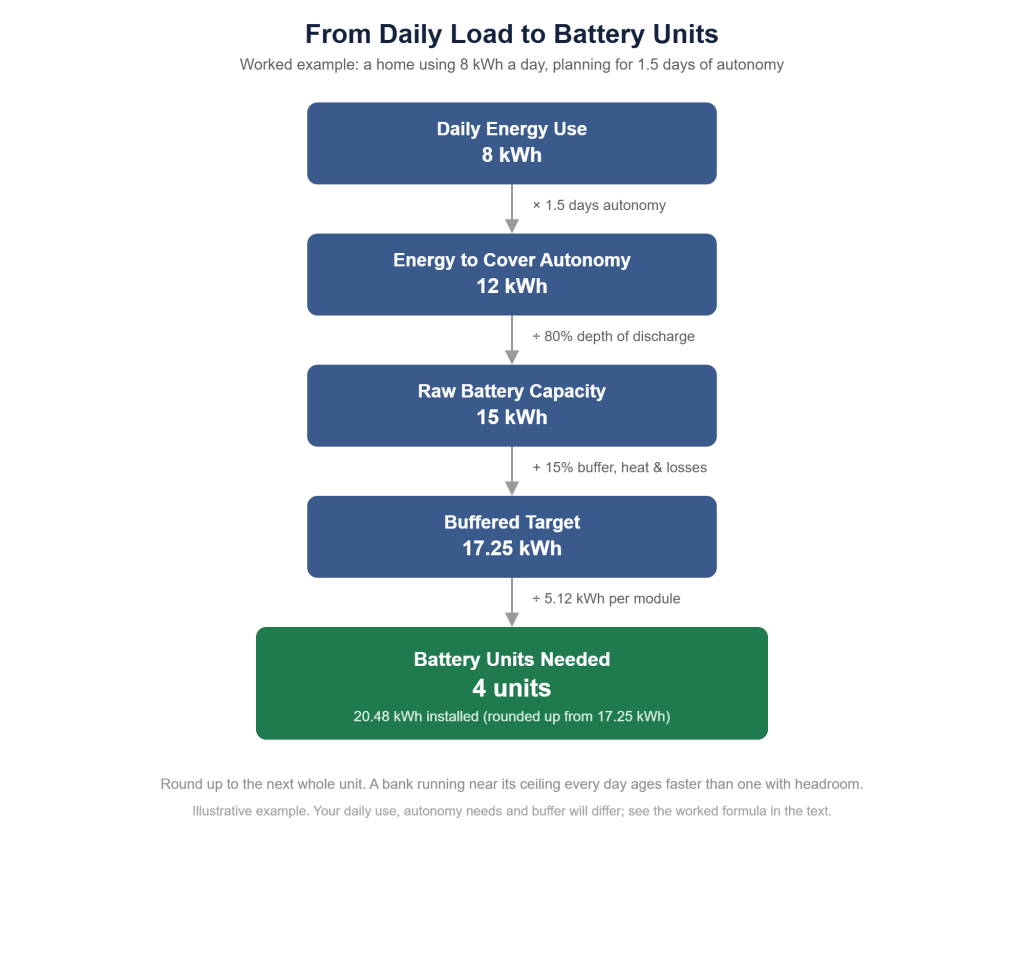
Take an example of a home using 8 kWh a day, planning for 1.5 days of autonomy. That’s a reasonable planning figure for northern and western India. Extended multi-day cloud cover during monsoon is less common there than in Kerala, Assam, or the hill states, where 2 to 3 days is more typical. With a LiFePO4 battery rated for 80% DoD, the maths runs:
8 kWh × 1.5 days ÷ 0.80 = 15 kWh required
Two adjustments are worth making to that raw number before it becomes a shopping list. The first is a temperature buffer. Lithium batteries lose usable capacity in extreme heat, and Indian summer rooftop temperatures are not gentle on hardware. A 10 to 20% buffer on top of the raw figure is standard practice for this reason specifically, not just general caution.
The second is round-trip efficiency: no inverter or battery converts and stores energy with zero loss, and a few percent is lost as heat in the process. Most sizing guides fold this into the same buffer rather than calculating it separately, since the two overlap in practice.
Applying a 15% combined buffer to the 15 kWh figure above brings the practical requirement to roughly 17.25 kWh. That’s still not a shopping list. It’s a target that has to be matched against whatever module size the battery actually comes in, which is where most sizing calculators stop.
Turning kWh into battery units
This is the step most sizing guides skip, because most of them aren’t written by a manufacturer with fixed module sizes to sell.
Invergy’s residential batteries, across the LiFePO4 (TB) floor-mount series, the Stack-Mount line, and the Wall-Mount line, all come in 5.12 kWh units. A 17.25 kWh requirement divides into those units as 17.25 ÷ 5.12 = 3.37, rounded up to 4 units, for a total installed capacity of 20.48 kWh. Rounding up rather than down matters here, because a battery bank running near its ceiling every day ages faster than one with some headroom left.
| Scenario | Daily Use | Autonomy | DoD | Raw kWh | +15% buffer | Units needed (5.12 kWh) |
| Partial backup: lights, fans, router | 3kWh | 1 day | 80% | 3.75kWh | 4.3 kWh | 1 |
| Full home backup, low monsoon-risk region | 8kWh | 1.5 day | 80% | 15kWh | 17.25kWh | 4 |
| Full home backup, high monsoon-risk region | 8kWh | 2.5 days | 80% | 25 kWh | 28.75 kWh | 6 |
| Daily self-consumption, backup secondary | 10kWh | 1 day | 80% | 12.5 kWh | 14.4 kWh | 3 |
The rack-mount line offers a second path to the same number. Its 10.0 model, at 9.6 kWh per unit, needs two units to clear a 17.25 kWh target. That means less installed headroom than four of the 5.12 kWh units, in exchange for fewer physical boxes.
Commercial and industrial sizing works the same way, at a different scale. A facility needing, for example, 140 kWh of buffered capacity would look at Invergy’s BESS C&I range instead of stacking dozens of residential-sized units. Individual system ratings there span roughly 51 to 177 kWh depending on configuration.
Whichever module size ends up on the order, there’s one more limit worth checking first. How many battery units can a given inverter model actually run in parallel over its BMS communication line? The kWh math might point to six units, but the inverter’s rated parallel limit is what actually decides the order. It’s worth confirming this with whoever is speccing the inverter before the battery count gets finalised.
Should you size for more autonomy than you would have a few years ago?
As LiFePO4 cell costs keep falling, the honest advice on autonomy days is shifting. A few years ago, cost pushed most residential sizing toward the bare minimum: backup for a few critical circuits and nothing more. As the price gap narrows, sizing for a full day or more of autonomy is becoming realistic for more homes, not just large installations. The same goes for sizing toward genuine daily self-consumption instead of backup alone.
That shift is also why the distinction between a backup system and a daily-cycling system matters more now than it did a few years ago. When battery capacity was expensive, most residential systems defaulted to minimal backup out of necessity. That default is loosening.
The bottom line
The honest answer to “how many batteries do I need” is never a single number pulled off some chart. It’s daily load, multiplied by autonomy days, divided by depth of discharge. Then you adjust for heat and losses, and round up to whole units of whatever the battery actually comes in.
Want a fast first estimate? Invergy’s solar calculator is a solid place to start. Just know it stops at system size and doesn’t calculate battery count on its own.
For the battery count specifically, run the formula above against Invergy’s residential or BESS module sizes. Or, honestly, just share your daily load figure with the Invergy team directly or you can contact us here.
Frequently asked questions
Do I need to know my exact daily electricity use to size a battery bank?
An estimate from a recent electricity bill is usually accurate enough to start. Divide the monthly units by 30 for a rough daily average, and adjust upward if backup needs to cover unusually high-draw days.
Is more autonomy always better?
No. Extra autonomy means extra battery cost that may sit unused most of the year. Match autonomy days to how often extended outages actually happen in your area, not to a worst-case scenario that rarely occurs.
Can I add more batteries later instead of buying everything upfront?
With modular systems like the Stack-Mount and Wall-Mount lines, yes. Additional units can usually be added later as budget or needs grow, provided the inverter’s parallel capacity has room left.
Does a bigger battery bank mean a bigger inverter?
Not necessarily. Inverter sizing is driven mainly by peak load, how much power is drawn at once, while battery sizing is driven by total energy over time. The two are related but sized independently.
How much does depth of discharge really affect the final battery count?
Significantly. The same 15 kWh requirement needs roughly twice the rated battery capacity at 50% DoD (lead-acid) as it does at 80% DoD (LiFePO4). It’s often the single biggest lever in the whole calculation.
Should I size for today’s usage or future usage?
If an EV, additional AC units, or other major loads are likely within the system’s lifetime, it’s worth sizing with some headroom now. That beats rebuilding the battery bank in a few years, particularly with modular systems, where adding capacity later is straightforward.

Invergy