

Solar System Calculator India 2026 – Calculate Your Solar Requirement & Best Inverter
Electricity bills in India continue to rise every year, making solar energy one of the smartest long-term investments for homes and businesses. However, one of the biggest questions people ask before installing solar panels is:
- How much solar system do I need?
- Which inverter is best for my home?
- How much money can I save with solar?
- What subsidy is available in India?
To simplify the process, Invergy Power Supply brings an advanced solar calculator that helps estimate:
- Recommended solar system size
- Best inverter type
- Government subsidy eligibility
- Monthly savings
- Estimated payback period
Whether you are planning a residential rooftop solar installation or a commercial solar setup, choosing the right inverter and system size is essential for long-term performance and savings.
Solar System Calculator
Use the iNVERGY Advanced Solar Calculator below to estimate your ideal solar system requirement based on your electricity bill and backup needs.
iNVERGY Advanced Solar Calculator
Calculate your ideal solar system size, estimated savings, subsidy, and inverter recommendation.
How the Solar Calculator Works
The calculator estimates your solar requirement based on your average monthly electricity bill.
Calculation Logic Used:
- Average electricity cost = ₹10/unit
- Average solar generation = 135 units per month per kW
This provides a more realistic solar sizing estimate for Indian households and businesses.
Example:
If your monthly electricity bill is ₹5000:
- Estimated monthly consumption = 500 units
- Recommended solar size = 3.5kW–4kW
The calculator also recommends the most suitable iNVERGY inverter based on backup requirements and property type.
Which Solar Inverter is Best for Your Home?
Choosing the right inverter is equally important as selecting the correct solar panel capacity.
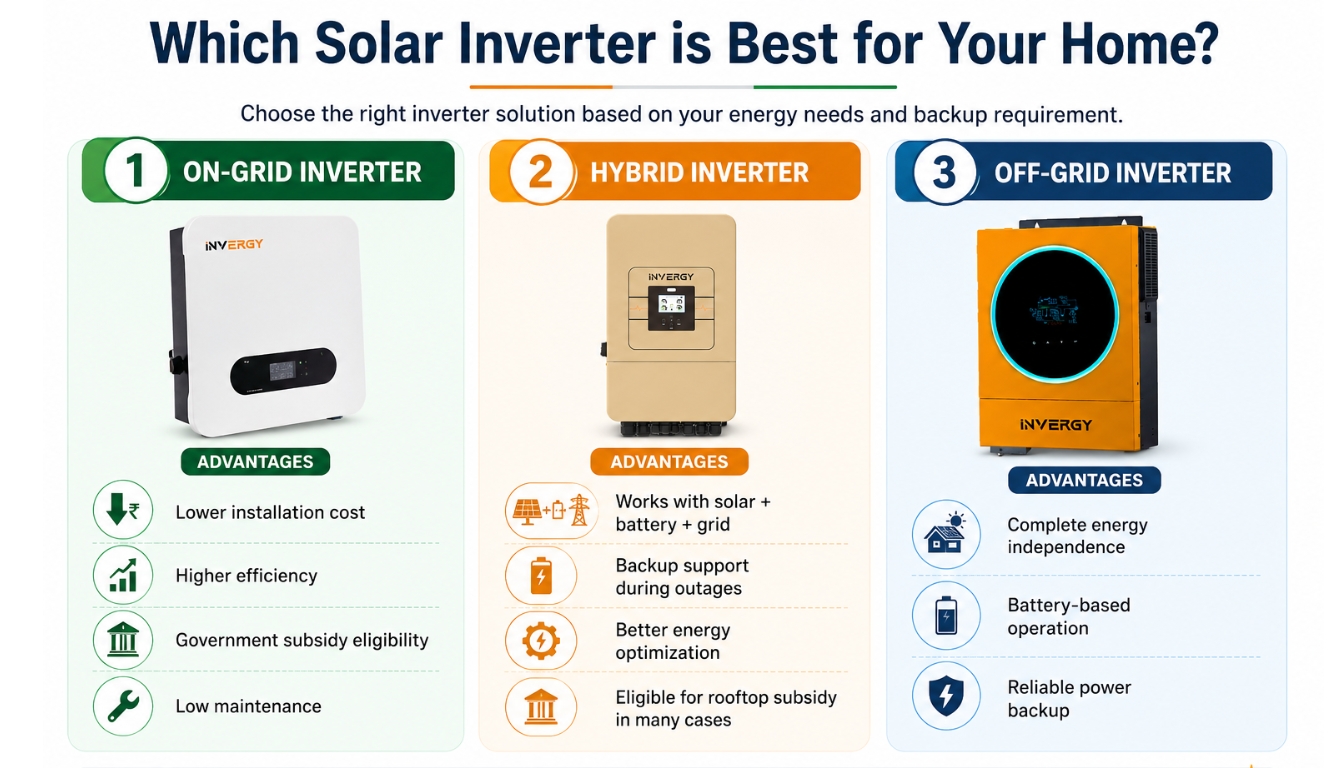
Invergy Power Supply offers three major solar inverter solutions:
1. On-Grid Inverter
Best for:
- Homes with stable electricity supply
- Users focused mainly on reducing electricity bills
- Residential rooftop solar systems
Advantages:
- Lower installation cost
- Higher efficiency
- Government subsidy eligibility
- Low maintenance
Explore:
INVERGY On-Grid Inverters
2. Hybrid Inverter
Best for:
- Homes needing backup during power cuts
- Smart energy management
- Battery-supported solar systems
Advantages:
- Works with solar + battery + grid
- Backup support during outages
- Better energy optimization
- Eligible for rooftop subsidy in many cases
Explore:
INVERGY Hybrid Inverter
3. Off-Grid Inverter
Best for:
- Remote locations
- Areas with unreliable grid supply
- Small backup-focused setups
Advantages:
- Complete energy independence
- Battery-based operation
- Reliable power backup
Explore:
INVERGY Off-Grid Inverters
Can a Solar Inverter Provide Backup During Power Cuts?
A standard on-grid solar inverter automatically shuts down during a grid outage for safety reasons, even when sunlight is available. If you need electricity during power cuts, choose a compatible hybrid or off-grid inverter with battery storage.
Solar System Size Guide
| Monthly Electricity Bill | Estimated Units | Recommended Solar System |
| ₹2,000 | 200 Units | 1.5kW |
| ₹5,000 | 500 Units | 3.5–4kW |
| ₹8,000 | 800 Units | 5.5–6kW |
| ₹12,000 | 1200 Units | 8–9kW |
| ₹20,000+ | 2000+ Units | 12kW+ |
Government Subsidy on Solar Systems in India
Under the PM Surya Ghar: Muft Bijli Yojana, residential rooftop solar systems can receive government subsidy support.
Current Subsidy Structure:
- Up to 2kW → ₹30,000 per kW
- 3kW and above → Up to ₹78,000 subsidy
Subsidy Eligibility:
| Inverter Type | Subsidy Eligibility |
| On-Grid Inverter | Eligible |
| Hybrid Inverter | Eligible in many cases |
| Off-Grid Inverter | Usually not eligible |
The final subsidy approval depends on:
- DISCOM approval
- Net metering
- State policies
- Rooftop eligibility
Important Requirements for Solar Subsidy
To receive the central subsidy under PM Surya Ghar, residential consumers must follow the scheme’s installation requirements. These include using eligible DCR solar modules, registering through the National Portal, and completing the required DISCOM inspection and commissioning process. The subsidy is transferred through Direct Benefit Transfer (DBT) after approval.
Commercial and industrial electricity connections are not eligible for the standard residential subsidy under this scheme.
Estimated Solar Investment & Savings
The calculator also estimates:
- Total solar system investment
- Government subsidy
- Final cost after subsidy
- Monthly electricity savings
- Payback time
Example:
A 5kW solar system may:
- Save ₹5,000–₹7,000 per month
- Recover investment within 4–6 years
- Continue generating savings for 20+ years
Why Choose INVERGY Solar Solutions?
Invergy Power Supply focuses on high-performance solar inverter solutions designed for Indian energy conditions.
Key Advantages:
- Smart inverter technology
- Hybrid energy management
- Battery compatibility
- Reliable performance
- Residential & commercial solutions
- Modern solar backup systems
Whether you need an on-grid, hybrid, or off-grid setup, iNVERGY offers scalable solar inverter solutions for homes, shops, offices, and commercial projects.
Related Solar Resources
You can also explore:
- Top 10 Battery Energy Storage System (BESS) Companies in India
- Top 10 LiFePO4 Battery Brands in India 2026
- Top 10 Solar Companies in India 2026
FAQs
How much solar system do I need for my house?
A house with a ₹5000 monthly electricity bill generally requires a 3.5kW–4kW solar system depending on usage and sunlight conditions.
Which inverter is best for home solar systems?
Hybrid inverters are best for homes requiring both electricity savings and backup during power cuts.
Can hybrid inverters get subsidy in India?
Yes, hybrid rooftop solar systems may qualify for subsidy under PM Surya Ghar Yojana subject to DISCOM and net-metering approval.
Is off-grid solar eligible for subsidy?
Pure off-grid systems are generally not eligible for standard rooftop solar subsidy.
How long does solar take to recover investment?
Most residential solar systems recover investment within 4–6 years depending on electricity usage and subsidy benefits.
How much roof space is required for a 5kW solar system?
A 5kW rooftop solar system generally requires around 400–500 square feet of shadow-free roof space. The exact requirement depends on panel wattage, layout, and installation design.
Does an on-grid solar inverter work during a power cut?
No, Standard on-grid inverters automatically disconnect during a power outage. A hybrid inverter with compatible battery storage is required for backup.
Do solar panels generate electricity during cloudy or rainy days?
Yes, Solar panels continue generating electricity during cloudy and rainy weather, but their output is generally lower than on sunny days.
Final Thoughts
Installing the right solar system is not just about adding solar panels — it is about choosing the correct inverter, system size, and energy management solution.
The INVERGY Solar Calculator helps simplify this decision by estimating:
- Solar requirement
- Savings
- Subsidy
- Payback period
- Recommended inverter type
For reliable solar inverter solutions in India, Invergy Power Supply offers advanced on-grid, hybrid, and off-grid inverter systems built for modern energy needs.
Invergy