

How BESS Cuts Demand Charges: Peak Shaving & Where the Savings Stop
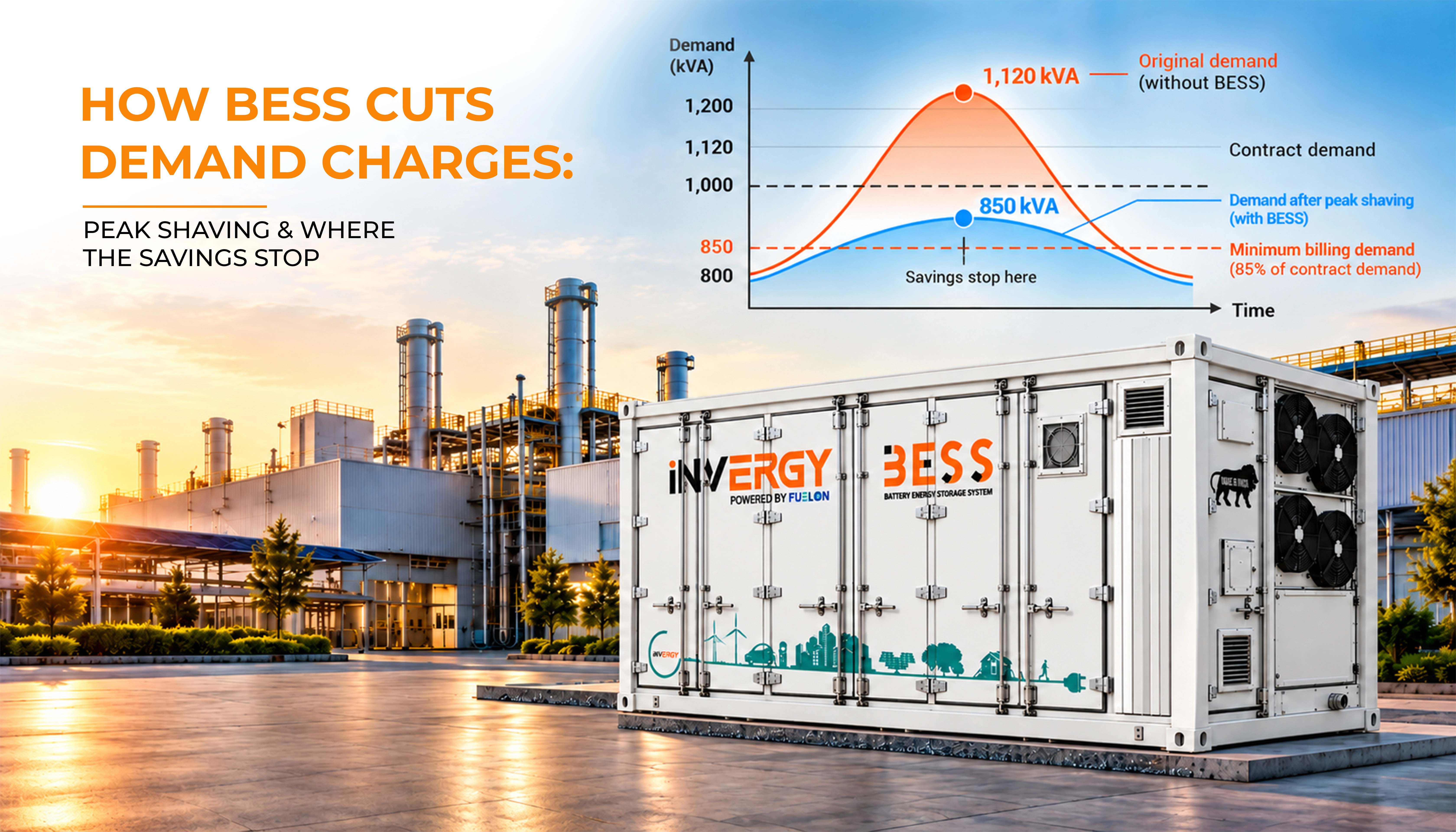
A factory can run carefully for 29 days and still get an expensive electricity bill because of one bad half hour. Two presses start together, the compressor kicks in, and the chillers are already running. For a short stretch, the plant pulls more power than at any other point in the month.
The meter remembers that moment. It sets the demand part of the bill, and it stays set until the next billing cycle.
Peak shaving is when a battery supplies power during periods of high electricity demand, reducing the amount of power drawn from the grid. The harder question, and the one most guides skip, is how much of your demand charge a battery can actually remove. Indian tariffs set a floor on the bill that no battery can eliminate on its own.
What does BESS peak shaving actually do?
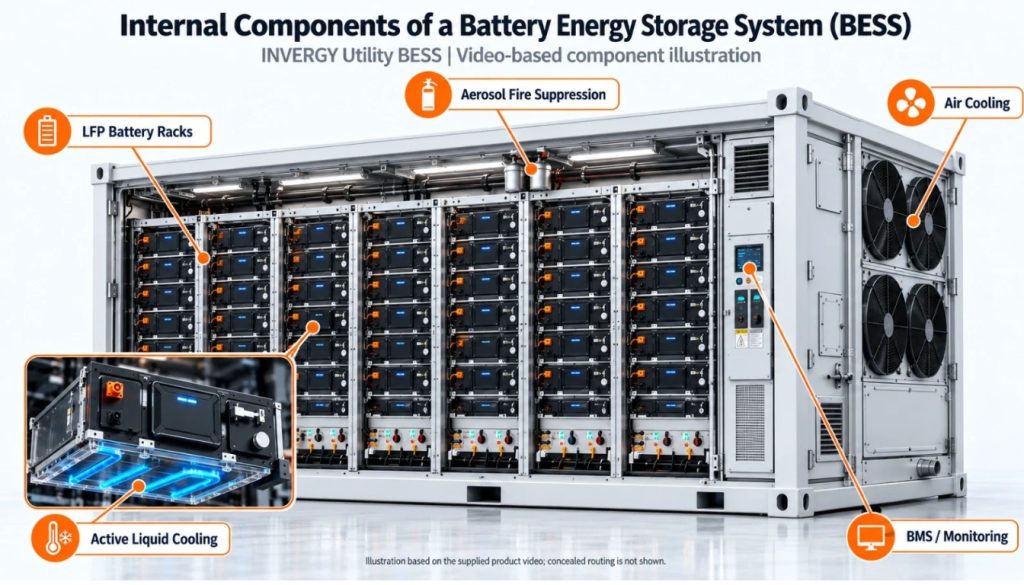
A battery energy storage system (BESS) is a battery bank with its own power converter (often called a Power Conversion System or bidirectional inverter) and controller, installed on your side of the utility meter. This is known as a Behind-the-Meter (BTM) BESS, installed on the customer’s side of the utility meter at a residential home, commercial building, or industrial facility. In contrast, a Front-of-the-Meter (FTM) BESS, also called a utility-scale BESS, sits on the grid side of the meter and supports the electricity network.
For peak shaving, it watches the load at the incoming supply. When the load climbs towards a limit you set, the battery discharges and covers the top slice, so the grid never sees the full peak.
When the load falls back, the battery recharges, ideally when grid power is cheap. The plant keeps running exactly as before, and nothing gets switched off. The only change is how much of the peak comes from the grid.
If you want the full picture of how the parts fit together, our guide to how a battery energy storage system works covers it.
Why can one short spike set a whole month’s demand charge?
Most HT and larger LT connections in India pay a two-part electricity bill. Energy charges cover the electricity consumed, measured in kWh or kVAh, depending on the applicable state tariff and consumer category. Demand charges are based on maximum demand (MD), which is generally measured in kVA and reflects the apparent power drawn by the facility.
The exact demand-measurement and billing rules vary by state and tariff category. For the worked example in this article, we use Gujarat because the Gujarat Electricity Regulatory Commission (GERC) publishes detailed, current tariff schedules with the demand measurement, contract demand, billing demand, and demand-charge rules needed to show how peak-shaving savings actually work. This is a Gujarat example, not a claim that the same rates or billing rules apply across India.
Under Gujarat’s current tariff schedule, maximum demand is measured as the average demand over a consecutive 15- or 30-minute period, depending on the applicable provision. The meter keeps the highest such reading during the billing month.
Two things follow from that. A spike lasting only a few minutes gets diluted by the averaging period, so it matters less than it looks on a live panel meter. A peak that holds through the full measurement window has a much bigger effect on the recorded MD, and that single highest reading can influence the demand charge for the entire month.
There is also your contract demand, the kVA you have agreed to take from your distribution licensee. If your recorded demand goes above it, the applicable tariff can charge the excess at a higher rate. That is why a short period of unusually high load can have a month-long effect on the demand portion of the bill.
Is peak shaving the same as load shifting?
No, though the same battery can do both. Peak shaving targets the single highest reading of the month. Load shifting moves energy use out of expensive time-of-day (ToD) hours into cheaper ones.
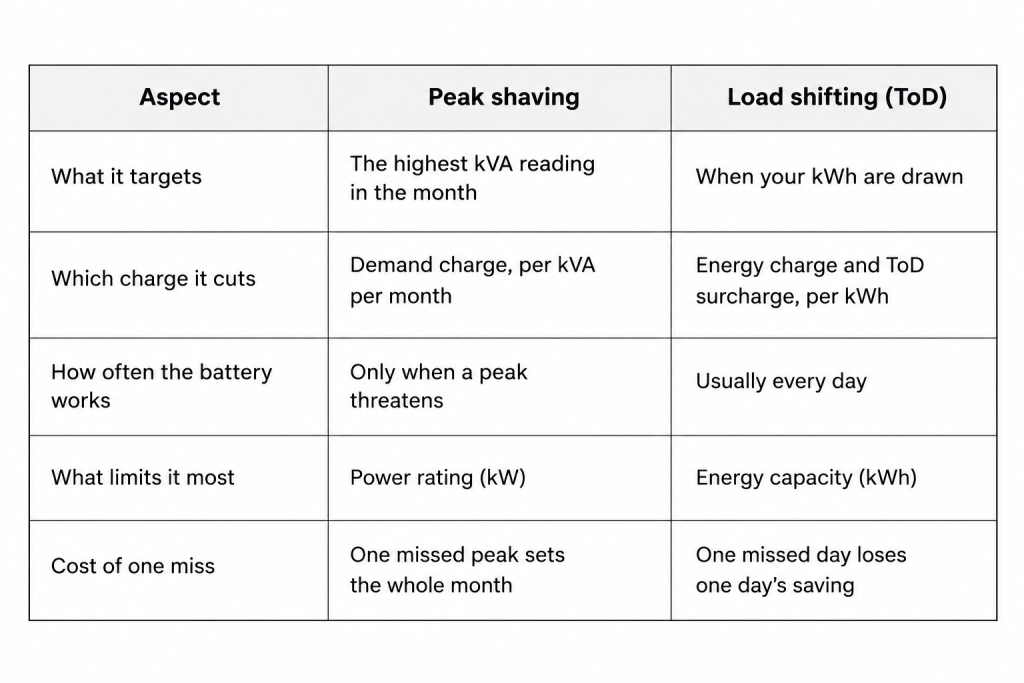
The two jobs compete for the same stored energy. Under Gujarat’s HTP-I tariff for HT connections of 100 kVA and above, the Time of Use (ToU) peak hours are 06:00 to 08:00 and 17:00 to 23:00. Different timings may apply to certain low-tension (LT) commercial categories, so the applicable tariff matters. If the battery uses its stored energy for ToU savings and the factory’s demand peaks at 19:30, there may be little charge left to shave that peak. The controller must prioritise demand reduction or ToU savings based on the site’s load profile and tariff.
Where do the savings come from, and where do they stop?
Most guides treat this as a straight line: shave a certain number of kVA, multiply by the demand rate, and that is the saving. Indian tariffs do not work that way. Each kVA you shave is worth a different amount depending on where it sits, and below a certain point it is worth nothing.
The reason is the billing demand clause. Your DISCOM does not simply bill your recorded MD. It bills the higher of your MD and a minimum share of your contract demand.
Gujarat’s HTP-I tariff, effective from 1 April 2026, sets billing demand as the highest of actual MD, 85% of contract demand, and 100 kVA. The percentage varies across states and tariff categories, so check the clause in your own tariff order.
Here are the Gujarat HTP-I demand rates we will use:
| Part of billing demand | Rate per kVA per month |
| First 500 kVA | ₹150 |
| Next 500 kVA | ₹260 |
| Above 1,000 kVA, within contract demand | ₹475 |
| Anything above contract demand | ₹555 |
Now take an illustrative factory with a contract demand of 1,000 kVA. In a bad month, the overlap of a shift start and a furnace cycle pushes recorded MD to 1,120 kVA.
| Battery holds MD at | Billed on | Monthly demand charge | Saving against no battery |
| No battery (1,120 kVA) | 1,120kVA | 2,71,600 | Nill |
| 1,000 kVA | 1,000 kVA | 2,05,000 | ₹66,600 |
| 900kVA | 900 kVA | ₹1,79,000 | ₹92,600 |
| 850 kVA | 850 kVA | ₹1,66,000 | ₹1,05,600 |
| 800 kVA | 850 kVA (floor) | ₹1,66,000 | ₹1,05,600 |
Demand charges only. Energy, ToD, and power factor charges are left out.
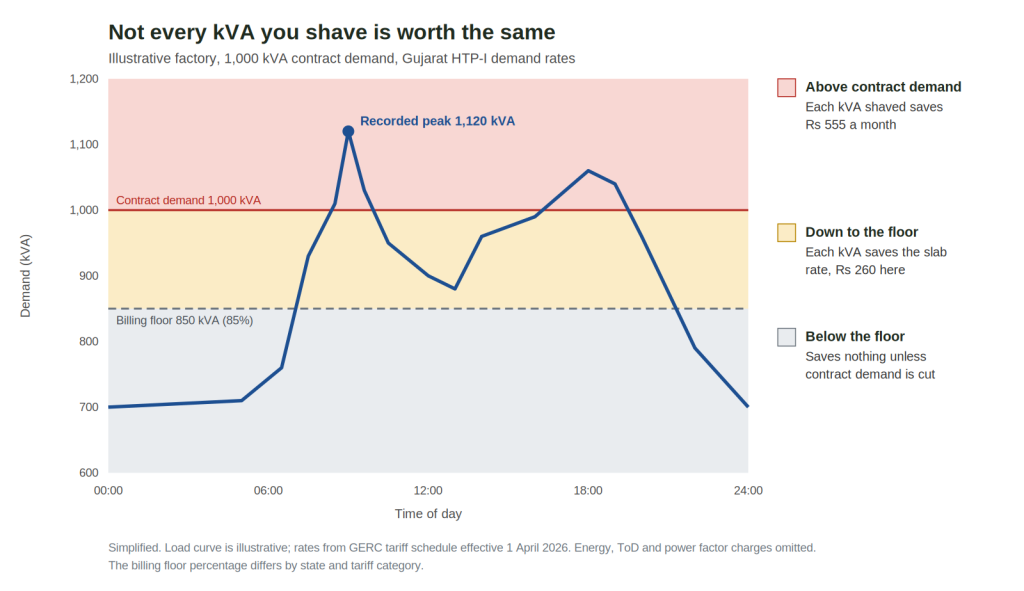
The first 120 kVA shaved earn more than twice as much per kVA as the next 150, and the last 50 earn nothing.
Read the table in three bands.
Above contract demand. Every kVA here is billed at the penalty rate, so each one shaved saves ₹555 a month. The first 120 kVA of shaving bring in ₹66,600. This is the cheapest slice to remove and the most valuable.
Between contract demand and the floor. Each kVA shaved here saves the slab rate it sits in, ₹260 in this example. Shaving from 1,000 kVA down to 850 kVA adds ₹39,000 a month.
Below the floor. Holding MD at 800 kVA earns exactly what 850 kVA earns, because the bill cannot drop below 85% of contract demand. A battery sized to shave that last 50 kVA costs more and pays nothing extra.
Getting through the floor means lowering contract demand
The only way below the floor is to lower the floor itself by applying to reduce your contract demand. Cut it to 900 kVA, keep MD at 800 kVA with the battery, and the floor falls to 765 kVA. The demand charge drops to ₹1,53,000, another ₹13,000 a month.
There is a catch that changes the risk profile of the whole project. With contract demand at 900 kVA, a month in which the battery misses the peak is billed at the penalty rate on everything above 900. If the old 1,120 kVA peak returns, the demand charge comes to ₹3,01,100, which is higher than having no battery and the old contract at all.
So once contract demand is cut, battery availability becomes a contract risk and not just an efficiency question. Gujarat’s schedule also states plainly that paying the excess charge does not give a consumer the right to draw above contract demand.
How do you size a battery for peak shaving?
Two numbers decide it, and they answer different questions.
Power (kW) decides how deep you can shave. A battery can only take off as much demand as its converter can deliver at once. A large battery behind a small converter still shaves only what the converter allows.
Energy (kWh) decides how long you can hold the line. It has to cover the full time your load stays above the target, including the averaging window. A rough starting point:
Energy needed (kWh) ≈ shave depth (kW) × hours above target ÷ usable depth of discharge ÷ round-trip efficiency
Depth of discharge is how much of the battery’s capacity you actually use. Round-trip efficiency is the share of energy that comes back out after charging and discharging. Both come from the product datasheet.
Your bill is in kVA, but the battery is rated in kW
This is the sizing detail that generic guides miss. If the battery supplies only working power, the reactive part of your load stays on the grid. The kVA reading then falls by less than the kW the battery delivers.
Take the same factory running at a 0.9 power factor with a 1,120 kVA peak. Bringing that down to 1,000 kVA with working power alone needs roughly 135 kW from the battery, not 120. Improving power factor first, with capacitor banks or similar correction, reduces the battery power you have to pay for.
Use interval data, not monthly bills
A monthly bill shows one MD figure. It does not show how many days came close, how long each peak lasted, or what time it arrived. Ask for 12 months of 15- or 30-minute interval data from your meter or energy monitoring system before anyone quotes a size.
Also check whether peaks come back-to-back. A plant with a morning shift start and an evening furnace cycle needs enough time and cheap power between them to recharge. Battery chemistry matters here too, because daily cycling adds up, and our comparison of LiFePO4 and lithium-ion cycle life sets out how the two chemistries differ.
What should you ask before you buy a battery for peak shaving?
- How is discharge triggered? A controller that reacts to a demand threshold at the incoming meter catches peaks whenever they arrive. One that only follows a fixed time schedule can miss a peak that comes early.
- Does it measure the way your DISCOM measures? The controller should track the same 15- or 30-minute average your billing meter uses. Otherwise, it will discharge at the wrong moments.
- Is the threshold set in kVA? You are billed in kVA, so a kW-only setting leaves a gap at lower power factors.
- How much charge does it hold back? If the battery also does ToD shifting or backup, ask how it reserves energy for the peak.
- What happens when it is empty or offline? You want an alarm and a fallback, especially if you plan to cut contract demand.
- What does your tariff actually say? Find the billing floor percentage, the excess demand rate and the integration window before you run any numbers.
Should you use a battery or a maximum demand controller?
A maximum demand controller does the same job by switching off non-essential loads as demand nears the limit. It is cheap and simple, but it works by stopping things, which a production line may not tolerate.
A battery keeps the load running and can also earn money through ToD shifting and cover short outages. Many plants use both: the battery shaves the peak, and the controller acts as a backstop if the battery is ever empty.
If you are weighing storage against other backup options too, our comparison of BESS and diesel generators sets out the cost and reliability trade-offs.
Where is this heading?
Tariffs are putting a larger gap between cheap and expensive hours, which makes a battery that already sits on site for peak shaving more useful. Gujarat’s HTP-I schedule now gives a 60 paise per unit discount between 11:00 and 17:00. In peak hours, it charges 85 paise per unit extra where billing demand is above 500 kVA.
That is a spread of ₹1.45 per unit before losses, available to the same battery on days when no demand peak threatens. Rules on how stored solar energy is treated are shifting as well, and our note on solar plus BESS under the 2026 captive power rules covers that change. For more ways storage earns its keep on a commercial site, see our overview of BESS applications in commercial and industrial projects.
The first step
Pull your last 12 months of bills and find three numbers: your contract demand, your highest recorded MD, and the billing floor in your tariff. If your MD regularly crosses contract demand, peak shaving is likely to pay, and if it already sits near the floor, the case rests on cutting contract demand, and that needs careful sizing.
INVERGY’s commercial and industrial storage range includes the i-Tank Pro, a 125 kW / 261 kWh cabinet built on LFP cells. It offers EMS-based charge and discharge scheduling, and Modbus TCP/IP communication for integration with building energy management.
Share your bills and contract demand with our team, and they can walk you through what a battery system for your site would need to cover.
Frequently asked questions
What is peak shaving with a BESS?
Peak shaving means using a battery to supply the top slice of a site’s power demand when it spikes. The grid sees a lower peak, so the maximum demand recorded on the bill is lower. The equipment keeps running as normal.
How much can a battery reduce demand charges?
It depends on how far your peaks rise above contract demand and where your tariff’s billing floor sits. Shaving above contract demand saves the most per kVA because that demand is billed at a penalty rate. Savings stop once billing demand reaches the floor.
Can a battery reduce demand charges below the minimum billing demand?
Not on its own. Most Indian tariffs bill at least a fixed share of contract demand- 85% in Gujarat’s HTP-I category- whatever your actual peak. To save more, you have to reduce contract demand, which adds risk if the battery ever misses a peak.
Is peak shaving the same as load shifting?
No. Peak shaving lowers the single highest demand reading in the month and cuts the demand charge. Load shifting moves energy use into cheaper hours and cuts the energy and time-of-day charges. One battery can do both if its controller manages the priority.
What size battery do I need for peak shaving?
The power rating in kW sets how much demand the battery can remove, and the energy capacity in kWh sets how long it can keep doing so. Both depend on your load pattern, so the reliable starting point is 12 months of 15- or 30-minute interval data from your meter.
Does rooftop solar alone reduce demand charges?
Not reliably. Solar lowers the units you buy, but peaks often fall in the early morning, the evening or a cloudy half hour, when solar output is low. A single such window can still set the month’s maximum demand, which is where a battery helps.

Invergy