Battery energy storage systems (BESS) are central to India’s shift toward reliable, low‑carbon energy. BESS store electricity produced by renewable energy sources like solar and wind, then release that battery energy when demand is high — improving grid stability, providing backup power, and reducing reliance on fossil fuels. This guide explains how battery energy storage works, the benefits and typical applications for homes, businesses, and grid operators, and what the market and technology landscape may look like by 2026.
Key Takeaways
- Battery energy storage systems (BESS) improve energy reliability and enable higher penetration of renewable energy on the grid.
- BESS are a practical solution for solar energy storage and help shift electricity use away from peak price periods.
- Battery storage delivers backup power for homes and businesses and supports grid services such as frequency regulation and peak shaving.
- Understanding BESS technology, components, and performance metrics is essential for selecting the right system by 2026.
- India’s energy market is rapidly adopting BESS as costs fall and government policies favor clean energy solutions.
- Both environmental (lower emissions) and economic (reduced energy costs, avoided demand charges) benefits make BESS a strategic investment.
Introduction to Battery Energy Storage Systems
Battery energy storage systems (BESS) are increasingly important for managing variable generation from solar and wind. As India’s electricity demand grows, BESS let operators capture surplus renewable energy and release it when needed — for example, to shave peak demand or to supply power during short outages — improving overall grid stability.
Wider adoption of renewable energy reduces reliance on fossil fuels and lowers emissions; BESS amplify that benefit by storing clean electricity for later use. Falling battery prices and government incentives for energy storage and rooftop solar are making battery storage more affordable for homes and businesses, while vendors and utilities work on solutions that bring down costs and improve performance (see “How Battery Energy Storage Systems Work” below).
Definition of BESS
A Battery Energy Storage System (BESS) is an integrated energy storage system that stores electricity in batteries and manages its dispatch to meet demand, support the grid, or provide backup power. As a modern energy solution, a BESS combines batteries, power conversion (inverters), and control software to capture surplus generation and release it when needed, improving flexibility and reliability across the energy system.
What is a Battery Energy Storage System?
BESS refers to a range of technologies that store electrical energy for later use. They charge when supply exceeds demand (for example, midday solar generation) and discharge when demand rises or when backup power is required. Systems scale from residential battery storage systems to large grid-scale installations and are used by households, businesses, and utilities.
By enabling storage and time-shifting of renewable energy such as solar and wind, BESS allows a higher share of clean generation to be used on the grid and reduces reliance on fossil-fired generation during peak periods.
Importance in Modern Energy Systems
In today’s energy landscape, BESS play several critical roles:
- Sustainability: Battery energy storage enables greater integration of renewables, lowering carbon emissions by displacing fossil generation when renewables are unavailable.
- Energy independence: Homes and businesses can store self-generated solar energy and reduce grid dependence, improving resilience.
- Grid stability: BESS provide fast-response services—such as frequency regulation, voltage support, and peak shaving—that balance supply and demand and enhance overall grid reliability.
Example: utility-scale BESS projects in several Indian states are already providing peak-shaving and inertial-response services, demonstrating how storage reduces the need for fast-ramping fossil plants (see the “How Battery Energy Storage Systems Work” section for components and operations).
| FeatureBenefit | |
| Energy Storage | Stores excess energy for later use |
| Grid Support | Balances supply and demand, enhances stability |
| Renewable Integration | Facilitates a higher percentage of renewables in the energy mix |
| Cost Savings | Reduces energy costs by optimizing usage |
How Battery Energy Storage Systems Work
Battery energy storage systems (BESS) operate on a simple cycle: they charge when electricity supply exceeds demand (for example, midday solar generation or low‑price grid power), store that energy in batteries, and discharge it as electricity when demand rises or during outages. This charge → store → discharge cycle enables businesses, utilities, and homes to improve backup power, perform peak shaving, and provide grid services.
Key steps in the process:
- Charging: The power conversion system (PCS) directs AC electricity (from the grid or solar inverters) to the batteries, converting it to DC. Charging typically occurs when generation is abundant or prices are low.
- Storing: Energy is held in the battery’s chemical form. State of charge (SoC) and depth of discharge (DoD) are monitored to preserve battery life.
- Monitoring & management: A Battery Management System (BMS) continuously monitors cell voltage, temperature, and state of health (SoH). Advanced BMS and supervisory control systems optimize charging rates, balance cells, and protect against faults.
- Discharging: When electricity is needed, the BMS and PCS convert stored DC back to AC and dispatch electricity to the load or grid.
- Repeat & optimize: Software controls and forecasting (sometimes AI-driven) schedule charge/discharge cycles to maximize value—minimizing costs, reducing peak demand charges, and providing ancillary services like frequency regulation.
Performance and numeric examples (typical values; verify with vendor specs): round‑trip efficiency for lithium‑ion systems usually ranges from ~85% to 95%; typical commercial systems respond within milliseconds to seconds for grid services; system durations commonly range from 1 to 6 hours depending on design (e.g., a 1 MW/4 MWh system supplies 1 MW for 4 hours).
Real‑world use case: a commercial facility can use a BESS to charge overnight at lower grid prices and discharge during daytime peaks to shave demand charges. A 500 kW system that shifts 2 MWh daily can cut a business’s peak demand billing exposure and improve resilience during short outages.
Monitoring and maintenance ensure long‑term performance: regular BMS reports on cycle counts, cell imbalance, and temperature trends guide preventive maintenance and help estimate remaining life. For grid operators, coordinated management across multiple BESS units can enhance grid stability, smoothing renewable output and reducing the need for fast‑ramping fossil plants.
Components of a BESS
To evaluate or specify a battery energy storage system (BESS), it helps to understand the primary components that make up the system and how they interact. A complete BESS combines batteries, power electronics, control systems, and balance‑of‑system equipment so the installation can store battery energy safely and deliver it as electricity when required.
Understanding the Key Components
The main elements of a BESS are:
- Batteries: The energy‑storing element (commonly lithium‑ion or flow batteries). Batteries determine capacity (kWh), power rating (kW), cycle life, and energy density.
- Power Conversion System (PCS) / Inverters: Convert AC to DC for charging and DC to AC for discharging. The PCS controls voltage, frequency, and synchronization with the grid or local loads.
- Battery Management System (BMS): Monitors cell voltages, temperatures, state of charge (SoC) and state of health (SoH); enforces safety limits and manages cell balancing to maximize life and performance.
- Energy Management & Supervisory Controls: Software that schedules charging/discharging to meet objectives (peak shaving, arbitrage, backup, grid services). Advanced systems may use forecasting and AI to optimize operations.
- Balance‑of‑System (BoS): Includes switchgear, protection, thermal management (HVAC or liquid cooling), cabling, enclosures, fire suppression, and monitoring hardware necessary for safe operation and grid interconnection.
Types of Batteries Used in BESS
Two widely used battery families are lithium‑ion and flow batteries. Below are comparative characteristics (typical ranges—verify vendor specs when designing):
| Battery TypeTypical MetricsAdvantagesDisadvantages | |||
| Lithium‑ion | Energy density: ~100–260 Wh/kg; Round‑trip efficiency: ~85–95%; Cycle life: ~2,000–8,000 cycles (chemistry dependent) | High energy density, compact footprint, high efficiency, fast response, falling costs | Higher upfront cost per kW in some installations; thermal sensitivity requires active cooling; recycling and raw‑material sourcing considerations |
| Flow batteries | Energy density: lower (tens of Wh/kg); Round‑trip efficiency: ~60–80%; Cycle life: >10,000 cycles; energy capacity scales with electrolyte volume | Easily scalable to long durations, long cycle life, lower risk of thermal runaway, flexible degradation profile | Larger footprint and weight, lower energy density, typically lower efficiency, higher balance‑of‑system complexity |
- Note: the numeric ranges above are illustrative—always confirm Wh/kg, $/kWh, and cycle life with specific vendor datasheets when specifying a project.
Short pros/cons summary:
- Lithium‑ion: best for compact, high‑power, high‑efficiency installations (residential to grid‑scale), rapid deployment, and markets where space and efficiency matter.
- Flow batteries: suited to long‑duration, high‑throughput use cases (multi‑hour energy shifting, some industrial and grid applications) where scalability and cycle life are priorities.
Balance‑of‑system considerations (often overlooked): proper sizing of PCS/inverters, switchgear, HVAC and fire‑safety systems, monitoring/telemetry, and site infrastructure (concrete pads, fencing, access) materially affect total system cost and performance. Voltage coordination, protection settings, and commissioning tests are critical to achieve the expected system performance and warranty conditions.
Semantically related terms to include when rewriting specifications or procurement documents: BMS, PCS, round‑trip efficiency, state of charge (SoC), depth of discharge (DoD), state of health (SoH), thermal management, and lifecycle cost. These terms help clarify performance and lifecycle expectations for battery storage systems used by utilities, commercial facilities, and power plants.
Benefits of Battery Energy Storage Systems
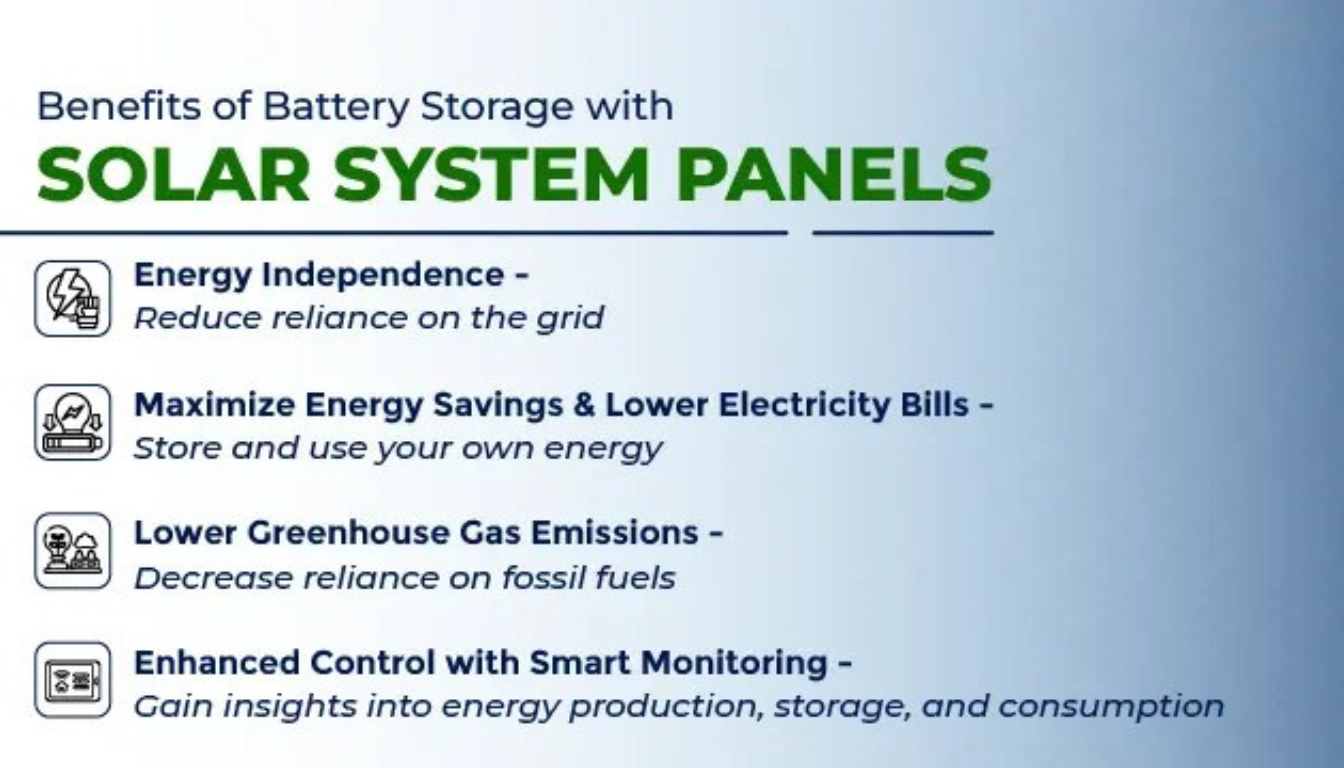
Battery energy storage systems (BESS) deliver both environmental and financial benefits that make them central to clean energy strategies. By storing low‑cost or renewable electricity and dispatching it when needed, BESS reduce emissions, improve grid flexibility, and can lower energy costs for homes, businesses, and utilities.
Environmental Advantages
BESS enable broader use of renewable energy by time‑shifting generation from variable sources such as solar and wind. Instead of curtailing excess midday solar, a BESS stores that electricity and supplies it during evening peaks, displacing fossil generation and cutting greenhouse gas emissions. In practical terms, when BESS replace peaker plants that run on diesel or gas, they reduce local air pollution and lifecycle carbon emissions—supporting cleaner, more resilient grids.
Tip: quantify impact for projects by estimating displaced generation (MWh) and multiplying by the local grid emission factor (tCO2/MWh) to calculate avoided carbon emissions.
Economic Benefits and Cost Savings
BESS deliver measurable cost savings. For commercial and industrial customers, battery storage can perform peak shaving—reducing maximum demand (kW) billed by utilities—and time‑shift energy to avoid high price periods. Example: a facility that uses a 500 kW BESS to shave a 200 kW portion of its peak can materially lower demand charges, often producing payback in a few years depending on local tariffs and incentives.
Other economic benefits include:
- Energy arbitrage: charge when prices are low, discharge when prices rise.
- Reduced reliance on diesel backup and lower outage-related losses (improved business continuity).
- Revenue from grid services (frequency regulation, capacity markets) where available.
Cost trends: battery storage capital costs (USD/kWh) have fallen significantly over the past decade, improving project economics—confirm current $/kWh figures from recent market reports when modeling a business case.
Next step (recommendation): for businesses and homeowners considering BESS, run a simple savings estimate comparing current electricity prices, demand charges, and expected battery dispatch to see payback timing; contact a supplier for a tailored proposal or use a downloadable calculator to model local tariffs and incentives.
Applications of BESS
Battery energy storage systems (BESS) have a wide range of applications across homes, businesses, and the electricity grid. By storing battery energy when generation or prices are favorable and discharging when needed, storage improves reliability, lowers costs, and enables higher shares of renewable energy.
Residential Applications
At the household level, battery systems paired with rooftop solar give owners greater energy independence and resilience. Typical residential installations range from 5–20 kWh (for example, a 10 kWh battery paired with a 3–6 kW solar array). Homeowners use BESS to consume more self‑generated electricity, reduce grid consumption during high‑price periods, and maintain backup power during outages.
Example: a 10 kWh residential battery can cover essential loads (lighting, refrigeration, communications) for several hours during an outage and reduce evening grid purchases by time‑shifting solar production.
Commercial and Industrial Applications
Businesses deploy industrial BESS to shave peak demand, perform energy arbitrage, and enhance power quality. Commercial systems are typically sized from a few hundred kW to multiple MW with durations of 1–4 hours depending on the use case. By lowering billed peak demand and avoiding costly start‑up of backup generators, battery storage reduces operating costs and improves continuity.
Case study (illustrative): A medium‑sized manufacturing plant installs a 500 kW / 2 MWh system to shave its peak by 200 kW daily; the resulting reduction in demand charges and avoided downtime can produce multi‑year payback depending on local tariffs and incentives—verify local rates when modeling savings.
Vendors such as Siemens and ABB provide integrated BESS solutions for commercial and industrial customers — typically combining battery modules, PCS/inverters, BMS, and site controls to deliver a turnkey system.
Grid-Scale Storage Solutions
Grid‑scale storage (tens to hundreds of MW and multiple MWh) supports utilities by providing capacity, frequency regulation, voltage support, and renewable firming. These storage systems increase grid stability by smoothing variable generation from wind and solar and by providing fast ramping to meet sudden demand changes.
Example: utility‑scale projects can be used for peak shaving, reducing reliance on quick‑start fossil plants, or deferring transmission and distribution upgrades. Large providers like Fluence and AES supply grid‑scale systems and services; in India and worldwide, such projects are increasingly used to stabilize grids with high renewable penetration.
Practical tips: when evaluating BESS for any application, match the battery power (kW) and energy capacity (kWh) to the intended function (backup, peak shaving, arbitrage, or grid services). Consider site constraints, required response time, cycle life, and vendor support. For commercial buyers, request an energy‑shift and demand‑charge savings analysis from suppliers to quantify benefits.

Battery Energy Storage Systems: Key Features
Battery energy storage systems (BESS) combine several features that determine how well they meet an application’s needs. When evaluating systems for homes, commercial sites, or grid deployments, focus on scalability, efficiency, measurable performance, and the technology stack (BM, PCS, and supervisory controls) that enables flexible, reliable operation.
Core feature checklist (what to measure and why):
- Scalability: Can the system be expanded modularly (add more battery racks or inverter units)? Typical modular increments are expressed in kW (power) and kWh (energy). Choose architectures that let you increase energy capacity without replacing the entire system.
- Round‑trip efficiency: The percentage of stored energy returned as usable electricity—commonly ~85–95% for lithium‑ion systems and ~60–80% for many flow batteries. Higher round‑trip efficiency reduces losses and operating cost.
- Cycle life and DoD (Depth of Discharge): Cycle life (number of full cycles before significant capacity fade) and recommended DoD affect lifetime energy throughput and lifecycle cost. Evaluate the expected cycle counts and how warranty terms handle degradation.
- State of Health (SoH) and State of Charge (SoC) monitoring: Look for BMS and telemetry that report SoH, SoC, cell imbalance, and temperature trends—these KPIs guide maintenance and predict remaining useful life.
- Power performance and response time: Specify required power (kW) and duration (hours). Response time (ms–s) is critical for services like frequency regulation and grid stability.
- Voltage and interoperability: Confirm nominal voltage, inverter compatibility, and control interfaces (Modbus, IEC 61850, etc.) to ensure system integration with existing infrastructure.
- Safety and thermal management: Effective HVAC or liquid cooling, fire detection/suppression, and protection settings are essential for reliable operation and to meet local codes.
How to evaluate performance during procurement and commissioning:
- Request vendor metrics: round‑trip efficiency, warranty on cycle life, calendar life, and expected degradation curves.
- Specify acceptance tests: capacity verification (kWh), power tests (kW), response time tests, and BMS telemetry validation.
- Require ongoing reporting: periodic SoH and cycle reports, remote monitoring access, and clear O&M/service SLAs.
| FeatureRecommended metric to requestWhy it matters | ||
| Scalability | Modular kW/kWh increments; maximum install size | Enables growth without full replacement |
| Efficiency | Round‑trip efficiency (%) | Impacts energy loss and operating cost |
| Performance metrics | SoH, SoC, cycle count, response time | Ensures reliability and predicts lifecycle |
| Technology innovations | AI forecasting, advanced BMS features | Improves dispatch optimization and life management |
Including these measurable metrics in specifications ensures procurement teams select storage systems that meet expected performance, help lower overall energy costs, and contribute positively to grid stability and local energy management.
Design and Supply of BESS Solutions by Manufacturers
Manufacturers and system integrators play a central role in translating battery technology into reliable, field‑ready energy storage solutions. Companies such as iNVERGY design, supply, and commission battery energy storage systems (BESS) that combine battery modules, power conversion systems, BMS, and site infrastructure to meet the needs of India’s growing energy market.
While no supplier can literally “ensure power is always available,” well‑designed BESS solutions significantly increase availability and resilience by providing backup power, fast grid services, and load‑shifting that reduce reliance on fossil fuel plants and improve overall energy security.
Role of Companies like iNVERGY
iNVERGY solutions (example supplier) typically offer end‑to‑end services—system design, supply of battery modules and inverters, integration of BMS and EMS (energy management systems), installation, commissioning, and O&M services. These integrated offerings simplify procurement for residential, commercial, and utility customers and help ensure system performance and warranty compliance.
Website: iNVERGY
Focus on Reliability and Scalability
Reliability and scalability are key buyer criteria. Reliable suppliers provide proven components, standardized commissioning tests, and clear maintenance plans. Scalable BESS architectures let customers add battery capacity (kWh) or power (kW) in modular increments as needs grow—important for sites expecting future expansion or higher renewable penetration.
Integration with Solar Energy Systems
Integrating BESS with solar is one of the most common and effective use cases: batteries store midday solar output and discharge during evening peaks, reducing electricity purchases and smoothing grid demand. Suppliers that offer seamless solar‑plus‑storage integration (inverters that manage both PV and storage, matching control logic, and coordinated EMS) simplify installation and improve overall system efficiency.
| AspectiNVERGY Solutions (illustrative)Competitor A (illustrative)Competitor B (illustrative) | |||
| Reliability | High — tested components, standard commissioning | Medium — good components, limited local support | Medium — variable performance across sites |
| Scalability | Excellent — modular architecture | Good — limited modular options | Fair — large upgrades required |
| Solar Integration | Seamless — integrated PV+storage controllers | Moderate — separate systems, integration effort | Poor — limited PV compatibility |
Procurement guidance (short checklist): request vendor references and site case studies, verify warranty on cycle life and performance, confirm O&M and remote monitoring services, review commissioning and acceptance test procedures, and ensure the vendor can meet local infrastructure and permitting requirements.
Next step (recommendation): for a firm quote and project feasibility, ask shortlisted suppliers for a proposal that includes expected costs ($/kWh), projected O&M services, recommended warranty terms, and an energy‑shift savings analysis specific to your tariff and site profile.
Future Trends in Battery Energy Storage
The outlook for battery energy storage systems (BESS) is strong as technology improvements, falling costs, and policy support accelerate adoption. India’s market is rapidly expanding alongside global growth—expect more advanced battery chemistries, smarter management systems, and business models that make storage a standard part of the energy infrastructure over the next few years.
Technological Advancements Expected by 2026
By 2026, several technology trends are likely to shape BESS performance and cost:
- Higher energy density: Continued improvements in cell chemistry and packaging will increase Wh/kg, enabling more battery energy in smaller footprints—important where land or space is constrained.
- Improved battery management systems (BMS): More sophisticated BMS and supervisory controls will extend life and maintain performance via better cell balancing, thermal control, and predictive maintenance.
- AI and advanced controls: Artificial intelligence and machine learning will enhance forecasting (solar/wind/price), optimize dispatch schedules, and automate lifetime‑maximizing charge/discharge profiles.
- Sustainable materials and second‑life strategies: Greater focus on recyclable materials, reuse of EV batteries in stationary storage (second‑life), and circular supply‑chain improvements will reduce lifecycle environmental impact and overall costs.
Market Predictions and Growth Potentials
Analysts project robust growth across residential, commercial, and industrial segments as policy incentives and declining costs drive adoption. (Note: confirm the latest market reports for region‑specific forecasts when modeling projects.) Key demand drivers include renewable energy integration, grid stability needs, and cost savings from demand‑charge reduction and arbitrage.
| SectorIllustrative Growth RateKey Drivers | ||
| Residential | ~15% annually (illustrative) | Rooftop solar incentives; resilience and self‑consumption |
| Commercial | ~20% annually (illustrative) | Demand‑charge savings, business continuity, energy management |
| Industrial | ~25% annually (illustrative) | Reliability, process stability, peak shaving and export revenue |
Risks and sensitivities: supply‑chain constraints (critical minerals), commodity‑driven cost fluctuations, and evolving regulations can affect price trajectories and deployment rates. When planning projects, use scenario modeling (base, optimistic, conservative) to account for these variables.
How buyers should prepare
- Prioritize modular, upgradable systems so capacity or power can be increased as needs evolve.
- Require clear warranty terms that cover cycle life and performance guarantees; understand degradation curves and O&M commitments.
- Consider second‑life battery options and end‑of‑life recycling plans in procurement to reduce lifecycle costs and environmental impact.
- Ask suppliers about AI/analytics capabilities and interoperability with existing energy management systems to future‑proof investments.
Overall, the next few years (through 2026 and beyond) will see BESS become more efficient, more intelligent, and more affordable—making storage an integral part of grids, power plants, and distributed energy systems that support renewable energy and a resilient energy infrastructure.
Conclusion
Battery energy storage systems (BESS) are a practical, high‑impact tool for making India’s and the world’s energy systems more reliable, efficient, and low‑carbon. By storing excess renewable energy and dispatching it when needed, batteries help reduce fossil fuel use, cut costs through demand‑charge mitigation and arbitrage, and strengthen grid resilience.
For businesses and homeowners, BESS can deliver near‑term bill savings and long‑term security; for utilities and power plants, storage provides fast‑response services that improve grid stability. As technology and markets evolve over the next few years, modular and well‑specified storage systems will become an increasingly cost‑effective part of clean energy strategies.
Next step: evaluate your site’s potential—use a simple savings calculator or request a project estimate from a qualified BESS supplier to compare costs ($/kWh), expected lifecycle performance, and available incentives. Investing in battery storage today helps lock in lower energy costs and supports a cleaner, more resilient energy future.