

Solar Inverter Types Explained: On-Grid, Off-Grid and Hybrid
Every solar quote eventually uses a word you were not expecting: on-grid, off-grid, hybrid, string, central. Nobody explains which one you are getting or why it matters, and the terms sound close enough to skip past.
They should not be skipped past. The inverter decides how your electricity actually behaves. It also decides whether you get power during an outage, and whether you can add batteries later without replacing equipment you have already paid for.
The same question comes up whether you are putting 3 kW on a house or 500 kW on a factory roof. So which of the solar inverter types actually fits your site, your budget and your power cuts?
What does a solar inverter actually do?
Solar panels generate direct current, or DC, electricity. Your building and the grid both run on alternating current, or AC. The inverter’s main job is converting one into the other, cleanly enough that the grid will accept it and your equipment will run on it without damage.
Beyond conversion, a modern inverter tracks sunlight levels and adjusts to draw the most power available at that moment. It can charge a battery if one is fitted. It can manage how a diesel generator and solar share a load, and report performance data to an app or a control room. A single component ends up doing five or six jobs.
What are the different types of solar inverters?
Solar inverters are classified two separate ways, and mixing them up is where most of the confusion starts. One classification is about connection: on-grid, off-grid or hybrid, describing how the inverter relates to the utility grid and to a battery. The other is about physical format: string, central, or micro, describing how many panels each inverter handles.
A solar system usually needs one answer from each list, not a single choice from six options. A household might end up with a hybrid inverter in a string format. A 5 MW solar plant is more likely to pair a central inverter with a plain on-grid connection.
Which inverter type fits your situation?
| If your priority is | Likely inverter type |
| Lower electricity bills, reliable grid | On-grid |
| Backup power during outages | Hybrid |
| Operating with no grid at all | Off-grid |
| A small roof with shading | Microinverter, on-grid |
| A large commercial or industrial rooftop | Three-phase string inverter, on-grid or hybrid |
| A utility-scale solar plant | Central or large three-phase inverter, on-grid |
The rest of this article explains why each row lands where it does.
What is an on-grid inverter?
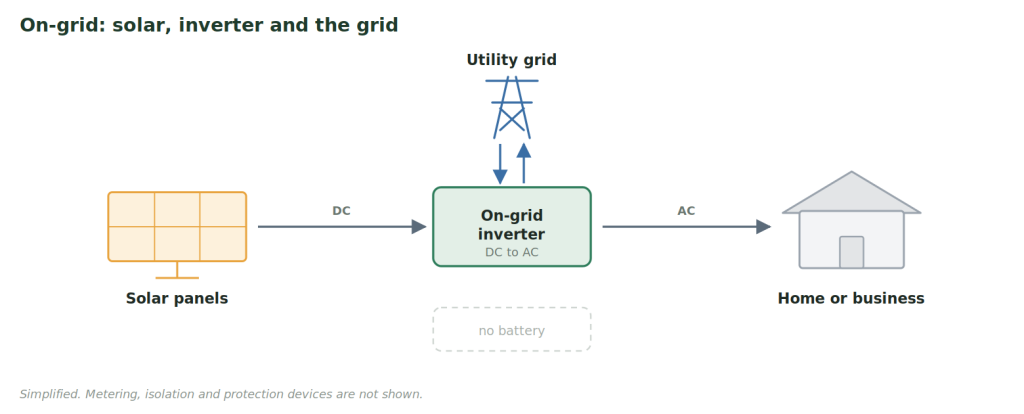
An on-grid inverter, also called a grid-tied inverter, connects your solar panels directly to the utility grid with no battery in between. During the day, the building draws from solar first and pulls any shortfall from the grid. Surplus power gets exported, and where net metering applies, the electricity board credits it against your bill.
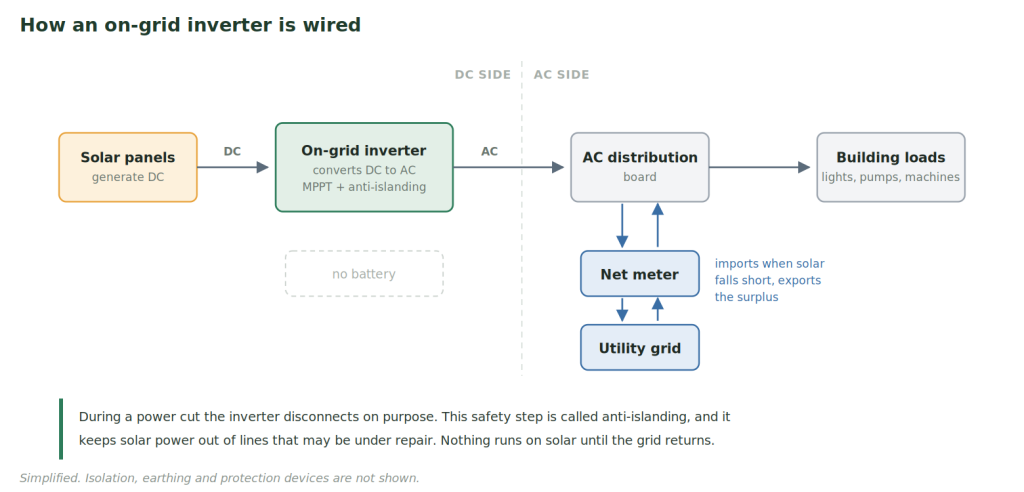
Why does this matter? A standard on-grid inverter shuts down during a power cut. This safety step is called anti-islanding, and it stops the system from feeding power into lines utility staff may be repairing. The trade-off is the headline fact about on-grid systems: lowest cost, no backup.
On-grid is the default across every segment where the grid is dependable. A home fits a single-phase unit of a few kW, while a factory or warehouse fits three-phase units sized to the roof. A solar farm uses large three-phase or central inverters feeding straight into the network.
On-grid also happens to be the type the residential subsidy is built around. Under PM Surya Ghar: Muft Bijli Yojana, the government pays ₹30,000 per kW for the first 2 kW and ₹18,000 for the third, capped at ₹78,000. It applies to grid-connected rooftop systems with net metering, so a standard on-grid installation qualifies and a pure off-grid one generally does not.
Our solar calculator estimates system size, savings and the subsidy for a given electricity bill.
The on-grid range spans all three, from small single-phase units up to a 350 kW three-phase inverter.
For commercial and industrial sites, the economics are usually stronger than for homes, because a factory consumes most of its own generation during working hours. That means fewer units exported at a lower credit rate and more offset at the full commercial tariff.
What is an off-grid inverter, and when do you actually need one?
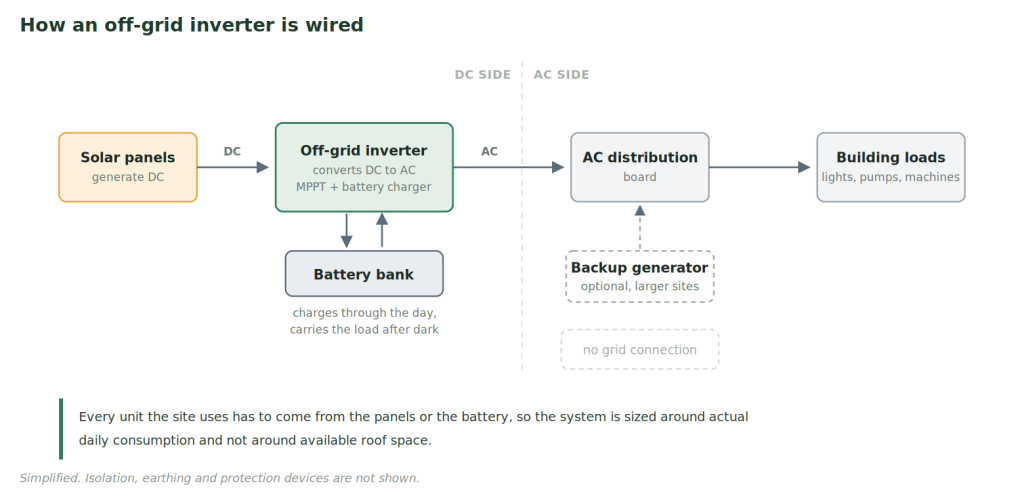
An off-grid inverter runs entirely on solar and battery power, with no grid connection at all. Every unit you use has to come from what the panels generate and the battery stores. That means the system has to be sized around actual daily consumption, not just available roof space.
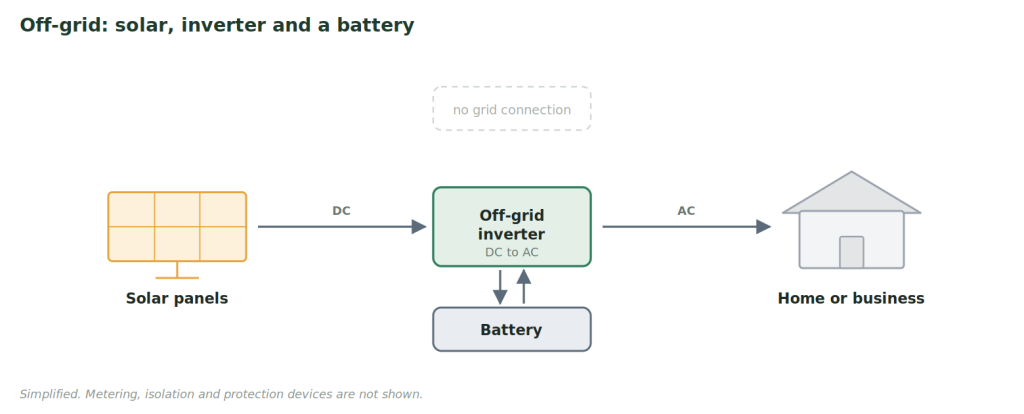
This makes sense for remote homes, farms, telecom sites, and industrial facilities where the grid is unreliable or does not reach at all. It rarely makes sense for a building with a stable connection. There, you would be paying for a much larger battery bank to replace something the grid already does for less.
Off-grid systems on larger sites usually run alongside a diesel generator instead of replacing it outright. The inverter manages the handover, running on solar and battery first and starting the generator only when both run short. Off-grid solutions cover both residential homes and commercial or industrial facilities, so the same connection type scales well beyond a single house.
What is a hybrid inverter, and why are more buyers choosing one?
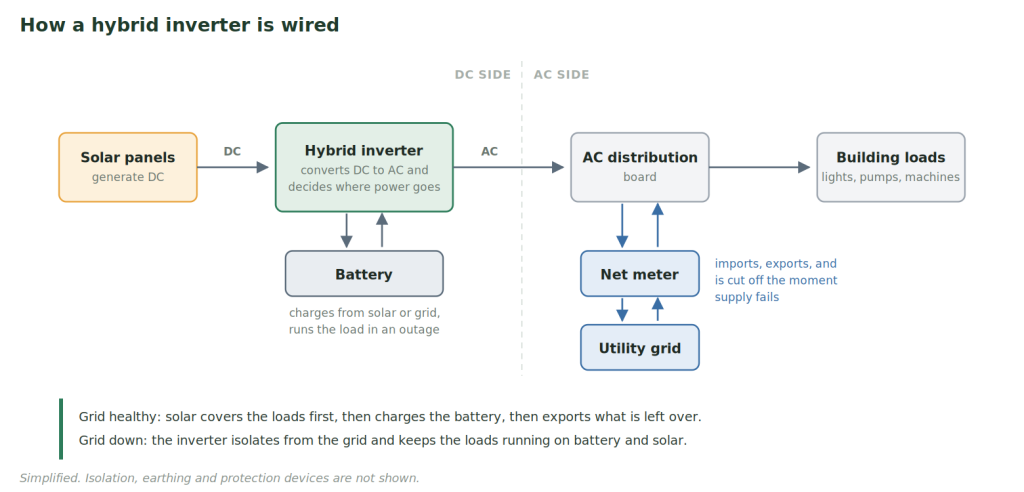
A hybrid inverter combines the on-grid and off-grid jobs in a single unit. It stays connected to the grid for daily use and export. It also charges a battery, so the system can switch to stored power the moment the grid drops.
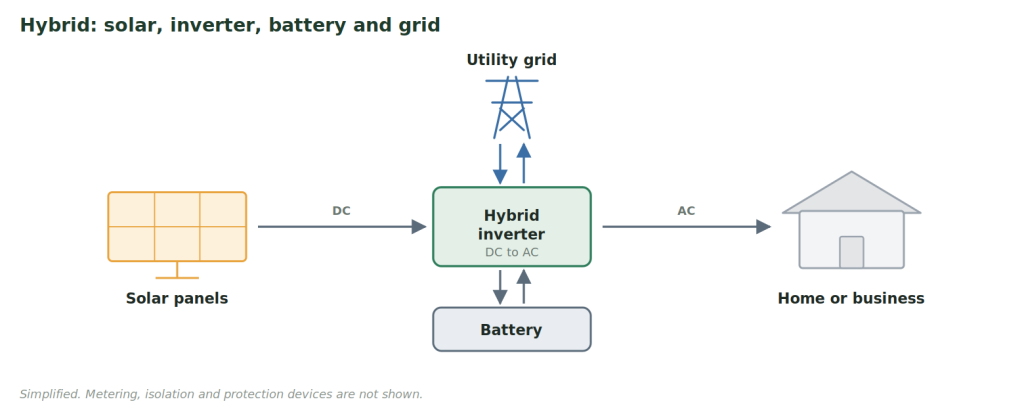
The appeal is flexibility, not one single feature. You get bill savings during normal operation and backup during an outage. Most systems let you size the battery to your budget now and expand it later as prices fall or needs grow.
The reasons differ by segment. A household wants the lights, fans and fridge to stay on. A business is usually protecting production time, cold storage or equipment that does not tolerate an unplanned shutdown. It may also be shifting stored solar into evening hours, when commercial tariffs are highest.
Hybrid systems can also qualify for the residential subsidy, subject to DISCOM and net-metering approval. Our guide to government policies and incentives can help you understand more about this.
Hybrid inverters run from small single-phase units for homes through three-phase models built for commercial and industrial loads.
On-Grid vs Off-Grid vs Hybrid Inverter: what changes between them?
| On-grid | Off-grid | Hybrid | |
| Grid connection | Yes | No | Yes |
| Battery required | No | Yes | Usually |
| Power during an outage | No | Yes | Yes |
| Upfront cost | Lowest | Highest | Mid to high |
| Typical residential use | Bill savings on a stable grid | Remote homes, no grid access | Frequent outages, planned battery |
| Typical C&I use | Rooftop generation against daytime load | Sites with no grid or very poor supply | Production continuity, evening load shifting |
| Typical utility use | Standard for grid-connected plants | Rare | Where storage is part of the plant design |
The choice usually comes down to one thing: how often the power actually goes out, and what that costs when it does.
String inverter vs Central inverter vs Microinverter: which format do you need?
Format is a separate question from connection type, and it is decided mostly by the size of the installation.
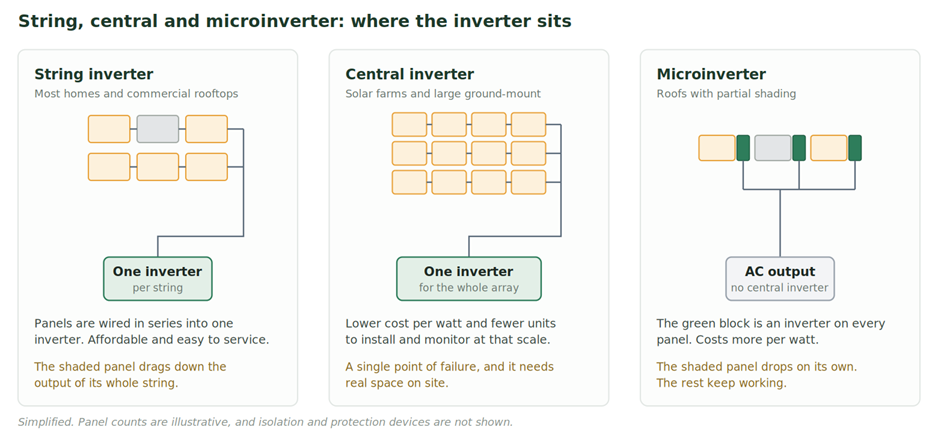
The shaded panel in the first and third cards is the same panel. Only the format changes what it costs you.
A string inverter connects one series, or “string,” of panels to a single inverter. Most homes use one or two strings, and most commercial rooftops use several string inverters spread across the array. It is the standard format across both because it is affordable, easy to service, and a single failure takes out one section rather than the whole system.
A central inverter is one large unit handling an entire array, used on solar farms and very large ground-mounted installations. The economics work at that scale: fewer units to install and monitor, and a lower cost per watt. The trade-offs are a single point of failure and a much bigger footprint on site.
Microinverters sit at the other end of the scale, with one small inverter per panel. That stops shading on one panel from dragging down the output of the whole string. They cost more per watt. On roofs with chimneys, water tanks or trees that shade different sections through the day, that premium usually pays for itself.
Do you need single-phase or three-phase?
This one is decided by your existing electricity connection, not by preference. Most homes in India run on a single-phase supply. Larger homes, commercial and industrial buildings typically use it because of their higher load requirements.
The inverter has to match the connection you already have. Check the sanctioned load and phase on a recent electricity bill before anyone quotes you a system, because a mismatch here is expensive to correct later.
Where does battery storage fit in?
Batteries turn up in the off-grid and hybrid conversations, and what counts as “a battery” changes enormously by scale.
- Residential. Lithium iron phosphate, or LiFePO₄, battery packs sized in a few kWh, usually mounted on a wall or stacked in a utility area. Enough to carry essential loads through an outage or into the evening.
- Commercial and industrial. A battery energy storage system, or BESS, sized in tens or hundreds of kWh. Used for backup, for cutting peak demand charges, and for shifting solar generation into expensive tariff windows.
- Utility. Grid-scale BESS installed alongside solar plants or on distribution networks, sized in MWh and designed around grid support duties rather than a single building’s load.
The inverter and the battery have to be compatible in voltage, communication, and charging behaviour. This is the single most common place where a system assembled from mismatched parts underperforms, so it is worth confirming before purchase and not after.
What should you check before you buy?
Eight things decide whether an inverter actually fits, beyond which connection type you pick.
- Capacity. Rated output should cover your panel size and peak load, with headroom for future additions. That holds whether the system is a few kW on a house or several hundred kW on a plant.
- Phase. Single-phase or three-phase, matched to your existing supply.
- Battery compatibility. If storage might come later, check if the inverter accepts a battery without being replaced.
- MPPT. Maximum power point tracking, or MPPT, is the circuitry that keeps the inverter drawing the most power the panels can give at that moment. More MPPT inputs help where panels face different directions.
- Backup behaviour. Ask what actually stays powered during an outage and how quickly the changeover happens, because “backup” covers a wide range of behaviour.
- Monitoring. Live visibility of generation, consumption and faults, through an app for a home or a central platform where a site team is responsible for uptime.
- Protection features. Anti-islanding, surge protection, overload and short-circuit protection, and an ingress rating suited to where the unit will be mounted.
- Warranty and service reach. Both matter more once something needs attention, months or years after installation.
For a fuller walk-through of the buying decision, see our inverter buying checklist.
Where is inverter technology heading in India?
Hybrid inverters are moving from a premium option towards the default recommendation in the residential segment. Battery prices keep falling, and outages remain a real concern in much of the country. App-based monitoring, once limited to expensive systems, is becoming standard even on mid-range units.
On the commercial and industrial side, the shift is towards storage attached to existing rooftop solar. As tariffs move towards time-of-day pricing, the value of holding daytime generation and using it in the evening rises. The question stops being which on-grid unit to buy. It becomes which hybrid unit, and how much storage alongside it.
The practical effect for a buyer in either segment is that backup and storage are getting easier to justify each year, not harder.
The type question comes down to one thing.
Most of the decision collapses into a single question: what does a power cut cost you? If the answer is “not much,” an on-grid system gets you the lowest price and the fastest payback. If the answer is “quite a lot,” a hybrid system with storage usually earns back its extra cost the first time supply fails for a few hours.
Invergy manufactures on-grid, off-grid and hybrid solar inverters across residential, commercial and industrial, and utility segments in India. The range also covers residential lithium battery storage, C&I battery energy storage and utility-scale BESS, with app-based monitoring of generation and consumption. If you are weighing up which type fits your property, share your roof size, connection phase and backup requirement.
The team can walk you through the options from there. You can contact us here.
Frequently asked questions
What are the different types of solar inverters?
Solar inverters fall into two groups: connection type, meaning on-grid, off-grid or hybrid, and format, meaning string, central or micro. Most buyers pick one option from each group based on grid reliability, site size and roof layout.
What is the difference between a string inverter and a central inverter?
A string inverter handles one series of panels, and homes and commercial rooftops typically use one or several. A central inverter is a single large unit for an entire solar farm, which suits utility-scale plants and not buildings.
Do hybrid inverters provide backup during power cuts?
Yes, as long as the battery has charge. A hybrid inverter switches to stored power automatically when the grid drops, which is the main reason people choose one over a plain on-grid system.
Can I add a battery to an existing solar system later?
It depends on the inverter already installed. A hybrid or hybrid-ready inverter usually accepts a battery later with little extra work; a basic on-grid inverter often cannot, and may need replacing.
Which inverter type suits a commercial or industrial rooftop?
Most start with three-phase on-grid string inverters, since a business consumes much of its own generation during working hours. Hybrid inverters with a BESS make sense where outages interrupt production or where evening tariffs are high.
Is a hybrid inverter worth the extra cost?
That depends on how often the power goes out and what an outage costs you, whether that is spoiled food at home or halted production at a plant. Frequent or lengthy outages usually justify it; occasional short ones may not.
What if part of my roof is shaded for part of the day?
A string inverter lets shading on one panel pull down the whole string’s output. Microinverters handle each panel separately, so shading stays a local problem instead of a system-wide one.
Invergy