

How to Choose a Solar Inverter: 9 Things to Check Before You Buy
Nobody buys a solar inverter quickly. Two weeks of research is normal, and most people take longer, which tells you something about how badly this information is organised.
I did the same rounds you are probably doing now. YouTube first, where every second video turns out to be a dealer with a discount code. Then Google, ten pages that all cover the same three points and stop exactly where your question starts. Then Reddit and the Indian solar groups, where someone who clearly knows what they are talking about answers half of it and the thread dies.
Two weeks in I had invested a lot of time on this research and still had no idea about which solar inverter should I choose. What I never found was one page that took the thing end to end.
So here is everything I had to piece together from a dozen places in an order. This Guide will help you to make the correct decision according to your needs
Your Solar Inverter Buying Checklist
Work down the list and skip ahead to whichever points are still open for you.
• The subsidy What PM Surya Ghar pays, what disqualifies you, and why your choice of inverter does not change the amount.
• The real cost Installed price, maintenance after the free years, and what the system works out to per unit.
• The size Reading your own bills to arrive at a number, and how many panels that inverter can carry.
• Your grid supply How often power fails where you live, the biggest input into the on-grid or hybrid decision.
• Your roof and weather Shading, orientation and where the inverter physically sits.
• Battery now or later. Whether a hybrid earns its premium, and what retrofitting costs instead.
• Warranty and service What the scheme already obliges your vendor to give you.
• Red flags The signs a quotation is cheaper for a reason.
• The shortlist Comparing final options without drowning in specifications.
Two quotations can both say “5 kW inverter” and be completely different products. One might be a plain on-grid string inverter, the other a hybrid with battery ports and backup output. If you compare only the price, the cheaper one always wins, and you find out why later.
The Subsidy Question: What Changes When You Go On-Grid
For homeowners in India, this often decides the whole configuration.
Central Financial Assistance under PM Surya Ghar: Muft Bijli Yojana is 60 percent of the benchmark cost for the first 2 kW and 40 percent for the additional 1 kW, with MNRE benchmarks of ₹50,000 per kW for the first 2 kW and ₹45,000 after that:
| System size | Central subsidy | Special category States |
| 1 kW | ₹30,000 | ₹33,000 |
| 2 kW | ₹60,000 | ₹66,000 |
| 3 kW and above | ₹78,000 | ₹85,800 |
Higher rates apply to Uttarakhand, Himachal Pradesh, J&K, Ladakh, the North Eastern states including Sikkim, and the UTs of Andaman & Nicobar and Lakshadweep. Nothing is paid beyond 3 kW.
What decides whether the money reaches you:
• The system must be grid-connected, on a residential property with a valid DISCOM consumer number.
• The vendor must be registered on the National Portal at pmsuryaghar.gov.in.
• Modules must meet the Domestic Content Requirement, meaning Indian-made modules built from Indian-made cells, and must be ALMM listed. Non-DCR modules anywhere in the installation make it ineligible.
• Payment comes after the work is done within 15 days of the DISCOM inspecting and approving the system on the portal.
• The scheme runs to 31 March 2027, capped at one crore active applications.
The part most buyers get wrong
Two details matter for anyone choosing an inverter.
First, the subsidy is calculated on the rated DC capacity of the modules, not the inverter. Install a bigger or smaller inverter and the CFA does not move, so paying for a better one costs you nothing in subsidy terms.
Second, a battery does not disqualify you. The guidelines allow storage as an additional component, with the CFA still worked out on module capacity alone. Battery hybrid systems are eligible subject to State Electricity Regulatory Commission approval, and the DISCOM checks reverse power relay protection during inspection. A fully off-grid installation gets no CFA at all.
So you can have backup and the ₹78,000, provided the system stays grid-connected, and your state’s rules allow it. Get your installer to confirm the inverter model and metering arrangement with your DISCOM before the order goes in, because State regulations differ and this is where applications stall.
What Home Solar Actually Costs, Maintenance Included
Every quotation shows one number: the installed price. Buyers who plan around that alone get an unpleasant surprise around year seven. Here is the full picture for a 3 kW system, the most common residential size in India because it captures the full subsidy.
A fully installed 3 kW on-grid system runs roughly ₹1.5 lakh to ₹2.2 lakh in 2026, about ₹55,000 to ₹70,000 per kW depending on module brand, inverter grade, structure height and roof complexity. The MNRE benchmark for the same system is ₹1.45 lakh. At a mid-range ₹1.8 lakh, the ₹78,000 subsidy leaves you around ₹1.02 lakh out of pocket.
Adding storage changes that. Lithium LFP lands between ₹18,000 and ₹30,000 per kWh installed, prices having fallen sharply over three years, so a 5 kWh pack with a hybrid inverter takes a 3 kW system into the ₹2.6 lakh to ₹3.5 lakh range before subsidy.
Two line items people forget. GST on renewable energy devices came down from 12 percent to 5 percent on 22 September 2025, but a rooftop installation is billed as a composite supply of goods and services, so the effective tax on your quotation sits above 5 percent. Ask for the break-up in writing. The net meter is also your cost, along with DISCOM processing charges that vary by state.
What you pay after that
| Period | Cost | What it covers |
| Years 1 to 5 | Nil for covered items | Your vendor owes you a free five year maintenance contract from commissioning, including repair or replacement of underperforming components |
| Year 6 onward | ₹3,000 to ₹8,000 a year for 3 to 5 kW | AMC with cleaning visits and electrical checks. Self-cleaning plus an occasional paid visit at ₹500 to ₹1,500 costs less |
| Year 10 to 15 | ₹30,000 to ₹1,00,000 | Inverter replacement, once during the system’s life for most owners |
| Year 10 to 15 with a battery | Varies with pack size | LFP packs are rated for 3,000 to 6,000 cycles and typically last 10 to 15 years |
Over twenty-five years: about ₹1.02 lakh net upfront, ₹80,000 to ₹1.2 lakh of maintenance from year six, and ₹40,000 to ₹60,000 for one inverter replacement. Call it ₹2.2 lakh to ₹2.8 lakh in total.
Against that, the scheme’s own estimate is that a 3 kW system generates more than 300 units a month; with Rajasthan and Gujarat rooftops sitting at the higher end of that, so roughly 90,000 to 1,00,000 units over its life. That works out to an effective ₹2.50 to ₹3 per unit against grid tariffs of ₹7 to ₹9 in most urban slabs. The government’s illustration puts a 300-unit household saving about ₹1,800 a month. Payback lands around four to six years once maintenance is counted, and improves every time tariffs rise.
Batteries change this maths. Storage adds cost without adding much bill saving, since the electricity was already yours either way. Where supply is reliable, a battery may never pay for itself on the bill alone. What you are buying is the ability to keep working through a cut, which is worth paying for on its own terms. Judge it that way instead of pretending it is an investment.
How to Calculate the Right Inverter Size for Your Home
The number on the box, 3 kW or 5 kW, is how much power the inverter can deliver to your house at any moment. It is not the number of panels you can attach, and the two are sized separately.
Your number comes off your electricity bills, not a load calculator app. Add up twelve months of units and divide by twelve to get a monthly average. One kW of well-installed rooftop solar generates about 4 units a day in India, roughly 120 units a month, though the national range runs from about 3.8 units in Kolkata and the North East to 5.2 in Rajasthan and Gujarat. Installers usually work to a more conservative 100 units per kW, which leaves headroom for monsoon months, dust and the slow decline in panel output over the years:
| Monthly consumption | Typical system size |
| 200 units | around 2 kW |
| 300 units | around 3 kW |
| 500 units | around 5 kW |
Three checks before you settle on that number.
Panels can exceed the inverter rating, within limits. Panels rarely produce their full rated output in real conditions, so installers deliberately connect a little more panel capacity than the inverter is rated for. A 5 kW inverter paired with 5.5 to 6.5 kW of panels is normal practice, not a shortcut. The scheme specification requires inverters to handle at least 20 percent overload, and your installer should confirm the array sits inside the limits printed on the datasheet.
Size for the house you will have, not the one you have today. An EV charger, a second AC or a borewell pump in the next few years changes the answer now. Adding capacity later means revisiting the inverter, the wiring and the DISCOM paperwork together.
Backup capacity is a separate number. On a hybrid, the solar rating tells you how much the inverter can generate, while the backup output tells you what the house can run during a cut. Check both. Phase is decided for you, since it follows your existing connection.
“Bigger is safer” is the most expensive assumption in this process. An oversized inverter costs more upfront and spends most of its life running at partial load, where it is least efficient. An undersized one caps output on your sunniest days, so you never see power the panels already produced. Aim for a close match with a little headroom.
Choosing an Inverter Based on Grid Reliability, Roof and Climate
Grid reliability. Steady supply and rare cuts mean a straight on-grid inverter does the job for the lowest cost. Lose power a few times a week, or face long cuts in summer, and the case for a hybrid gets strong quickly. Anyone already running a conventional inverter and battery for backup is paying for two systems that do not talk to each other, and a hybrid replaces both.
Roof and shading. A water tank, a parapet or a neighbour’s building throwing shade for part of the day costs more than people expect on a single string, because output follows the weakest panel. This is what MPPT channels are for. Each Maximum Power Point Tracker manages a group of panels independently, so one channel suits a single unshaded roof face while two or more earn their place when panels face different directions or catch shade at different times. Microinverters solve the same problem at higher cost, and a clean unshaded roof needs neither. The scheme guidelines expect a shadow analysis report from the vendor, so ask for it.
Heat. Inverters derate when they overheat, which means less output exactly when the sun is strongest. The scheme specification assumes an ambient range of -20°C to 60°C and requires IP 65 protection outdoors, IP 54 indoors. An inverter bolted to a west-facing wall in Jaipur or Nagpur will still have a shorter life than the same unit in a shaded, ventilated spot. Decide where it sits before installation day, not on it.
Should You Choose a Battery-Ready (Hybrid) Inverter?
Plenty of buyers want solar now and a battery in two or three years, once prices settle or the budget recovers. That is a reasonable plan, and it is exactly what a hybrid inverter is for.
“Battery ready” should mean the inverter already has the DC battery input, the charge control logic and the backup output built in, with nothing left to add later except the battery itself. Some products use the phrase to mean an optional module can be bought separately. Ask which one you are being sold.
The cost comparison is simple enough to do on paper. A hybrid costs more than an on-grid unit of the same capacity today. Retrofitting later means either replacing the inverter or bolting on a separate battery inverter, plus a second round of labour and rewiring. If storage is a genuine plan and not a maybe, paying the difference upfront is cheaper. If you are confident you will never add a battery, the on-grid unit is the honest choice.
Making a hybrid work as both on-grid and off-grid
A hybrid does not force you into one mode, and most quality units let you switch through the app or installer settings.
In grid-tied mode, it runs like any on-grid system, using solar first, exporting surplus to the net meter, and pulling from the grid when solar falls short. In backup mode, when the grid drops, it isolates from the network and runs connected loads from solar and battery. That isolation is called islanding protection, and it exists so your system cannot feed power into a dead line while somebody is working on it. Self-consumption mode keeps as much solar in the house as possible and exports only the surplus. Time-of-use scheduling matters in states with time-differentiated tariffs, where the battery charges on cheap power and discharges during expensive hours.
Two things to sort out during installation. First, decide which circuits go on the backup line, since lights, fans, fridge, router, and one AC is a typical set and putting the whole house on backup empties the battery in an hour. And second, confirm your DISCOM and State Commission accept the arrangement, since battery hybrid systems qualify for CFA only with that approval in place.
Warranty, Support and Certifications to Check Before Buying
Under PM Surya Ghar, the vendor owes you more than most buyers realise: five years of operation and maintenance from commissioning, a five-year system warranty, free repair or replacement of underperforming components in that window, and a plant Performance Ratio of 75 percent maintained through those five years. Module warranties are specified separately, above 90 percent of rated output at ten years and above 80 percent at twenty-five.
Beyond that minimum, inverters usually carry a five-year manufacturer warranty with extensions available. Read what an extension covers before comparing years: a ten-year warranty that excludes the power electronics, or makes you ship the unit somewhere at your own cost, is worth less than five years with on-site replacement.
Service networks matter more here than anywhere else. A cracked panel is an annoyance, and the rest keep working. A dead inverter is a dead system, and every day it waits for a part of the generation is lost. Ask where the nearest service centre is, the usual turnaround, and whether replacement units are stocked locally.
On compliance, ALMM applies to modules, and DCR modules are what the subsidy requires. Inverters have to comply with the Quality Control Order for Solar Photovoltaic Inverters dated 30 August 2017, along with IS 16221 or IEC 62109 for safety and IS 16169 or IEC 62116 for islanding prevention. Ask for the certificates. Manufacturers who have them hand them over without being chased.
Red Flags That Should Make You Walk Away
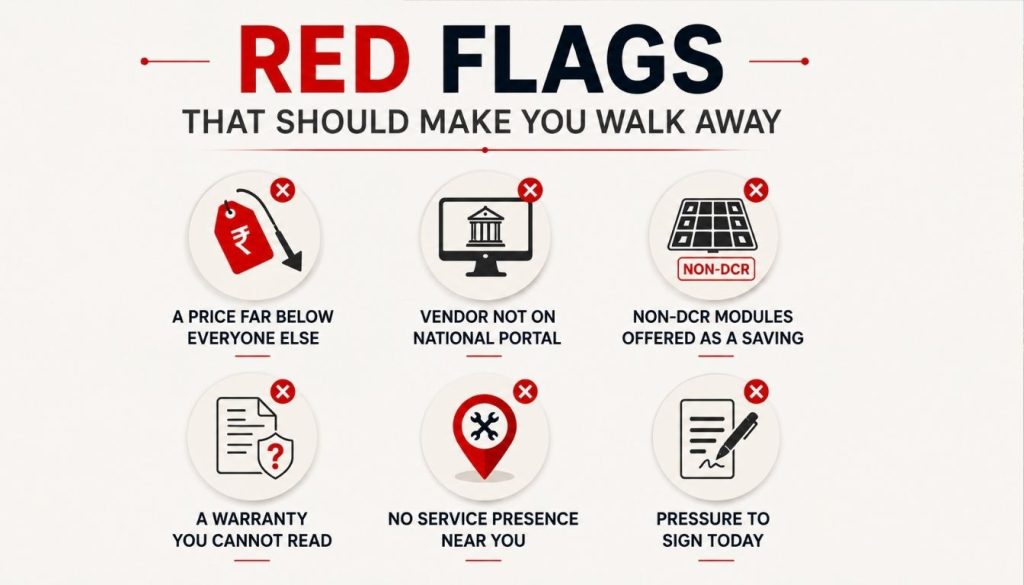
A price far below everyone else. Hardware pricing is fairly tight across serious brands. A quotation undercutting the rest by thirty percent has cut something you cannot see yet, usually the structure, the protections, or the after-sales commitment.
A vendor who is not on the National Portal. No registration means no subsidy, and finding that out after installation is the most common way households lose the ₹78,000.
Non-DCR modules offered as a saving. Skipping DCR saves maybe ₹10,000 on a 3 kW system and forfeits ₹78,000.
A warranty you cannot read. If nobody can hand you the document with terms and exclusions, treat the warranty as decorative.
No service presence near you. A national helpline number is not a service network. Ask for the address of the nearest centre.
Pressure to sign today. The discount that expires this evening usually reappears next week. Nobody selling a twenty-five-year asset needs a decision in one sitting.
A Practical Way to Shortlist Your Final Options
Once you are down to two or three inverters, stop comparing them against each other and compare them against your own situation. Take your monthly consumption, the hours your area loses power in a typical week, whether a battery is in the plan, and whether you are claiming the subsidy. Then ask, for each option, what your bill looks like in year one, what happens during a cut in July, what it costs once the free maintenance years run out, and how long a service call would take where you live.
Usually one option answers those better than the others, and it is often not the one with the longest feature list. The best inverter suits your load, your grid and your roof. That is a different answer in Gurgaon with stable supply and a flat unshaded terrace than in rural Maharashtra with four-hour cuts through summer.
This is also where most buyers go back to a dealer and get pushed towards whatever that dealer stocks. Worth knowing that iNVERGY builds on-grid, off-grid and hybrid inverters with matched battery storage, so the sizing conversation is not steered by what happens to be in the warehouse. If your supply is stable, we will tell you an on-grid unit is enough. If you lose power three times a week, we will size the backup circuits with you instead of selling you a battery bigger than your evening load.
Send us your last twelve months of bills and your PIN code, and we will come back with a size, a configuration, and a straight answer on whether a hybrid is worth it for your household. You can contact us here.
If you would like to hear it from customers rather than from us, our Google Business Profile carries reviews and ratings from households and businesses we have installed for.
Frequently Asked Questions
What size inverter do I need for my solar panels?
Match the AC rating to your household load, then confirm the array fits inside its DC input window. A 5 kW inverter carrying 5.5 to 6.5 kW of panels is standard practice.
Does a battery cost me the subsidy?
No. The CFA is worked out on module capacity alone, so storage earns nothing extra and takes nothing away. Battery hybrid systems qualify with State Commission approval and a DISCOM check on reverse power relay protection. A fully off-grid system gets no subsidy.
What does a home solar system cost in total, including maintenance?
For a 3 kW on-grid system, ₹1.5 lakh to ₹2.2 lakh installed and around ₹1.02 lakh net after the ₹78,000 subsidy. Maintenance is free for five years, then ₹3,000 to ₹8,000 a year, with one inverter replacement between years ten and fifteen. Lifetime spending lands near ₹2.2 lakh to ₹2.8 lakh against 90,000-plus units of electricity.
Why choose iNVERGY?
Because we make the product instead of reselling somebody else’s. We build the full range, on-grid, off-grid and hybrid, with battery storage designed around our own inverters, so the recommendation you get depends on your supply situation and not our stock position. Our units meet the specification set out under PM Surya Ghar, which keeps the subsidy route open. And when something needs attention in year eight, the service call reaches the people who built the unit.
Can I upgrade my inverter later without replacing my panels?
Usually yes, provided the new inverter’s voltage and current input range suits your existing array. Moving from on-grid to hybrid also brings battery wiring, a backup distribution board and fresh DISCOM paperwork into the picture.
Is a more expensive inverter always better?
No. Above a certain point, you are paying for features your home will never call on, such as extra MPPT channels on an unshaded roof. Price differences that reflect build quality, service reach and warranty terms are worth paying for. Differences that reflect a longer feature list are not.
How long does a solar inverter typically last?
Ten to fifteen years for a well-made unit, against twenty-five for the panels, so most owners replace it once. Heat decides whether you get ten years or fifteen, which is why mounting location deserves more attention than it usually gets.

Invergy