

BESS Sizing for Commercial Buildings in India: Size It Against Your Bill
India’s energy storage market is growing. Prime Minister Shri Narendra Modi emphasized the nation’s need for indigenous battery storage at the Bharat Renewable Energy Summit & Expo 2026, held at Bharat Mandapam. The Union Cabinet has also sanctioned a ₹14,500 crore VGF scheme in 2026 for 92 GWh of grid-scale energy storage projects, of which 30 GWh is to be BESS.
The CEA’s May 2026 report on rationalising consumer fixed charges recommends two key changes for consumers with loads above 50 kW:
- A two-part tariff with an HT demand charge of ₹/kVA/month.
- kVAh metering for electricity consumption.
These changes make demand measurement and tariff structures important considerations when sizing commercial battery storage systems.
A commercial building’s electricity demand can rise sharply when equipment such as chillers, pumps, and elevators operates simultaneously. BESS can help reduce these demand peaks, but its capacity must be sized according to how much demand needs to be reduced and for how long.
This guide covers BESS sizing for commercial buildings in India and how BESS billing demand floors, kVA metering, power factor, and time-of-day tariffs will impact appropriate kW and kWh unit capacity.
What does BESS sizing actually mean?
A battery energy storage system, or BESS, stores electricity and releases it when needed. Sizing a battery means determining two things: how much power it needs to deliver and for how long.
- Power (kW): Think of this as the battery’s speed. It tells you how much power the battery can supply at a given moment and how many loads it can support simultaneously.
- Energy (kWh): Think of this as the battery’s endurance. It tells you how much energy the battery stores and how long it can keep supplying power before its usable capacity runs out.
For example, a 125 kW / 250 kWh BESS system can theoretically deliver 125 kW continuously for about two hours.
The key is not to size the battery based on the building’s total connected load. You size it around the load you actually want the battery to manage.
A BESS brings together several components to perform this job:
- Battery cells and modules: Store energy.
- Battery Management System (BMS): Monitors battery health.
- Power Conversion System (PCS): Handles AC/DC conversion.
- Energy Management System (EMS): Controls charging and discharging.
Together, these components determine how the system operates and what job it can perform.
If you are new to how these systems are built, our guide to how a BESS works covers the basics and its applications.
What job is the battery doing?
The first sizing decision is the job, because each job pulls the numbers in a different direction.
| Job | What sets the kW | What sets the kWh | Data you need |
| Peak shaving | Height of the peak above your target | How long the peak lasts | 15-minute interval data, 12 months |
| Time-of-day shifting | Load during the peak tariff window | Length of the peak window | Your tariff schedule and hourly load |
| Backup for critical loads | Critical load, plus motor starting current | Hours of backup you want | A list of critical circuits and their running load |
| Solar self-consumption | Evening load you want to serve | Solar surplus you can store | Solar generation and load, hour by hour |
A battery can serve multiple purposes, but its usable capacity must be allocated carefully. Peak shaving and solar storage can often share capacity because afternoon peak demand and solar surplus occur around similar times. However, if backup is also a priority, some energy must be reserved for it rather than used for daily peak shaving. For more on how batteries support different needs at commercial sites, see our overview of BESS applications in commercial and industrial projects.
Why does your electricity bill change the BESS sizing decision?
Don’t size a battery only from your building’s load curve. The way your electricity bill is calculated matters just as much.
Two-Part Tariffs and the Demand Component
Commercial and industrial electricity bills generally have two main components: fixed or demand charges, based on the sanctioned or recorded demand, and variable energy charges, based on the electricity consumed in kWh. The CEA’s May 2026 report on rationalising consumer fixed charges recommends a standardised two-part tariff structure across states, with HT demand charges expressed in ₹/kVA/month and kVAh-based billing for consumers with loads above 50 kW.
The CEA report shows that billing demand is not always based on the highest demand recorded during the month alone. In 15 of the 16 states studied, it is calculated using whichever is higher: the recorded maximum demand or a specified percentage of the contract demand. The demand recording interval, typically 15 or 30 minutes, varies according to the state’s tariff and metering rules.
For BESS sizing, this means a short demand spike can influence the demand charges for the entire billing month. A battery must therefore be sized to reduce the recorded peak without ignoring the minimum billing-demand requirement.
Does your tariff have a billing demand floor?
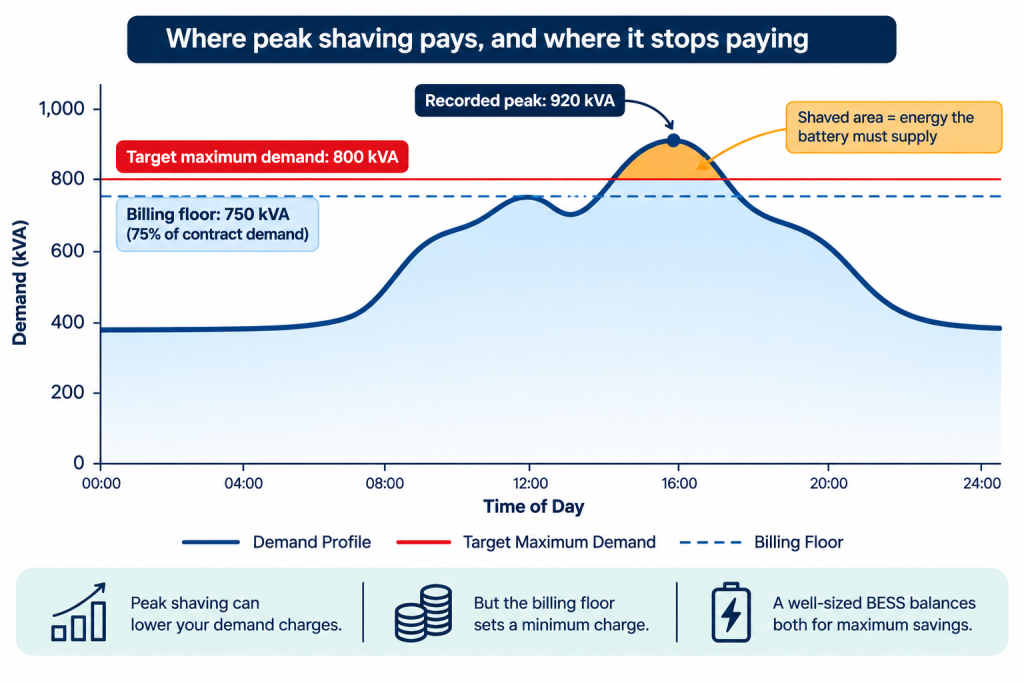
Your recorded peak is not always the same as the demand used for billing. Some tariffs set a minimum billing demand linked to your contract demand.
For example, Kerala’s tariff framework has used 75% of contract demand as a minimum billing level for certain consumers. Karnataka’s tariff rules also show that the billing method can vary by consumer category. For some LT demand-based commercial and industrial consumers, the billing demand is the higher of the sanctioned load or the maximum demand recorded during the month.
So, if your contract demand is 1,000 kVA and your applicable billing floor is 75%, the billing demand cannot fall below 750 kVA.
This creates an important BESS sizing limit. If your battery already reduces the recorded peak to the billing floor, making the battery larger may not create additional demand-charge savings unless you also reduce your contract or sanctioned demand, where permitted.
The exact floor depends on your state, tariff category, and current tariff order, so check those details before setting the battery’s peak-shaving target.
Is your demand measured in kVA or kW?
Another detail matters when your building is billed for demand in kVA.
A BESS is normally specified by its power output in kW, while the meter may record demand in kVA. The relationship between the two depends on the building’s power factor. The Central Electricity Authority’s metering regulations define power factor as the relationship between active and reactive components of an AC electrical load.
For example, a building with a 920 kVA peak at a 0.92 power factor has about 846 kW of active power at that point. If the target is 800 kVA, the battery output needed to make that reduction is not simply 120 kW.
So don’t size the battery by subtracting two kVA numbers and treating the result as kW. Use the actual load and power factor data to calculate the required battery output.
How does the time-of-day tariff affect kWh?
Peak shaving is not the only reason to use a BESS. If electricity costs more during certain hours, the battery can charge when rates are lower and discharge when rates are higher.
The Electricity (Rights of Consumers) Amendment Rules, 2023 set the framework for time-of-day (ToD) tariffs. For commercial and industrial consumers with maximum demand above 10 kW, the rules establish three important points:
- Evening peak rates: Electricity during peak hours must cost at least 20% more than the normal rate (1.20 times the standard tariff).
- Solar-hour rates: Electricity during the notified eight solar hours must cost at least 20% less than the normal rate.
- What these rates apply to: These increases and discounts apply to the energy charge (based on units consumed in kWh), not the fixed demand charges.
The respective State Electricity Regulatory Commission or State Load Despatch Centre sets the actual peak and solar-hour timings.
For BESS sizing, the practical question is much simpler:
How many hours does the expensive period last, and how much load do you want the battery to cover during those hours?
That determines how much kWh you need.
For example, a battery designed only for a short afternoon demand spike may need much less energy capacity than one designed to discharge throughout a long peak-tariff window. A BESS can also follow a “Happy Hour” strategy: charge during the lower-tariff solar hours and discharge during the more expensive evening peak. This lets the building shift some electricity consumption to cheaper hours. Therefore, check your current state tariff before deciding the battery’s storage duration.
Choosing a BESS for commercial and industrial applications
Once the required power and energy capacity are established, the battery’s operating features also matter.
For example, Invergy’s i-Tank Pro Max from its Utility Series combines LFP battery technology with an integrated PCS, two-level BMS, and three-tier fire suppression. Its advanced liquid-cooling system uses an 8 kW chiller, while its supported operating modes include grid-independent, standalone, and backup operation.
With a design life of 10 years and at least 6,000 cycles at 70% State of Health (SOH), i-Tank Pro Max is designed for demanding energy storage applications. Features such as battery monitoring, thermal management, and fire protection are important when evaluating a BESS alongside its usable capacity, discharge power, and efficiency.
A worked example: sizing for a 1,000 kVA commercial building
The figures below are illustrative. Use your own interval data and your supplier’s datasheet values.
The building. Contract demand: 1,000 kVA. Billing floor is 75%, so 750 kVA. Recorded peak: 920 kVA on weekday afternoons, at a power factor of 0.92.
Step 1: Set the target: The target has to sit above the floor to earn anything. The interval data shows the load passes 800 kVA only between about 2 pm and 4 pm, so 800 kVA is a sensible target. Going lower would mean covering the late-morning shoulder too, which needs a much larger battery.
Step 2: Size the power: Holding 920 kVA at 800 kVA takes about 132 kW, as shown above.
Step 3: Size the energy: Adding up the kW that must be shaved in each 15-minute block across the two hours gives about 180 kWh.
Step 4: Convert to installed capacity: Batteries are not run from full to empty, and some energy is lost in conversion. The table shows how the 180 kWh grows.
| Adjustment | Illustrative value | Result |
| Energy to deliver | From interval data | 180 kWh |
| Usable depth of discharge | 90% | 200 kWh |
| Discharge efficiency | 95% | about 211 kWh |
| Capacity left at end of planned life | 80% | about 264 kWh |
Step 5: Check the recharge: The battery must refill before the next afternoon. Here it has overnight and morning hours, which is ample. A building with two peaks a day would need to check this carefully.
The result is roughly 135 kW and 265 kWh, a two-hour system. The demand charge saving is 120 kVA multiplied by the demand rate in your tariff schedule, every month the peak would otherwise have occurred.
Notice what a load-curve-only method would have done. Aiming at the average daytime load of around 650 kVA would have produced a far larger battery, and every kVA shaved below 750 would have earned nothing.
What should you check before asking for a quote?
- Twelve months of interval data: Monthly bills show the peak but not its shape. Your DISCOM or your own energy meter can usually supply 15-minute or 30-minute data.
- Your tariff category and its floor: The billing demand definition sits in the tariff schedule for your category. Note whether it is 75%, 85%, 100% or something else.
- Your contract demand history: If your peaks have fallen, reducing contract demand may be worth doing whether or not you add a battery.
- The meter’s averaging method: Some meters use a sliding window for maximum demand. A battery that responds late can still let a short spike through.
- Critical loads, if you want backup: List them with running and starting loads. Lift motors and pumps can draw several times their running current at start. For a comparison with generators, see our guide to BESS versus diesel generators.
- Where the system will sit: Floor loading, ventilation, access for maintenance, and fire safety all affect which product fits. Battery chemistry matters here too; our note on LiFePO₄ safety features explains why.
- Datasheet figures, in writing: Ask for usable capacity, depth of discharge, round-trip efficiency, C-rate, and the capacity guaranteed at the end of the warranty.
Where Are India’s BESS Targets and Regulations Heading?
India’s energy storage plans are moving towards large-scale deployment. According to the Central Electricity Authority’s National Electricity Plan, the projected BESS requirement is 47.24 GW / 236.22 GWh by 2031–32.
Three major developments highlight this expansion:
- Green Energy Corridor Phase III: Approved in September 2026, it includes 50 GWh of BESS deployment and supports the evacuation of up to 135 GW of renewable energy by FY 2032–33.
- ₹14,500 crore VGF scheme: Approved in November 2026, it supports 92 GWh of grid-scale energy storage, including 30 GWh of BESS capacity.
- BESS safety regulations: The CEA’s 2026 safety amendment introduces additional requirements for battery monitoring, fire protection, ventilation, and emergency shutdown. These regulations take effect on 1 April 2027.
Getting the size right
The right battery for a commercial building is the smallest one that removes the peaks your bill actually charges for. That means reading the tariff schedule alongside the load curve, not after it.
Invergy and its C&I BESS range include rack-based systems designed for commercial and industrial facilities aiming to reduce peak demand charges. It also includes the i-Tank Pro, a 125 kW / 261 kWh system with EMS-based charge and discharge scheduling.
Have 12 months of electricity bills and interval data? Send them to us, and our team can walk you through what a system for your building would need to cover.
Frequently asked questions
How do I calculate the right BESS size for a commercial building?
Start with the job: peak shaving, time-of-day shifting, backup, or solar storage. Use 12 months of 15-minute load data to find the kW you need to remove and the kWh across the peak. Then adjust for usable depth of discharge, efficiency, and ageing to reach installed capacity.
What is the difference between kW and kWh in a battery?
kW is how much power the battery can deliver at once. kWh is how much energy it stores. A 100 kW, 200 kWh battery can supply 100 kW for about two hours.
Why did my demand charge not fall after installing a battery?
The usual reason is the billing demand floor. Many Indian tariffs charge on a fixed share of contract demand even when your recorded peak is lower. If the battery pushed your peak below that floor, the extra shaving saves nothing. Check your tariff schedule and consider applying to reduce contract demand.
Can one battery handle peak shaving and backup together?
Yes, but not at full capacity for both. Energy reserved for outages cannot also be used on the daily peak. Decide how many kWh to hold back for backup and size the rest for shaving.
How many hours of storage does a commercial building need?
It depends on the job. Peak shaving often needs one to three hours, depending on how long the peak lasts. Time-of-day shifting needs enough to cover your DISCOM’s peak window. Backup depends on how long you want critical loads to run.
Does time-of-day tariff apply to my building?
The central rules require ToD tariffs for commercial and industrial consumers with maximum demand above 10 kW, with state commissions setting the details. A March 2026 draft proposes 1 April 2027 as the deadline. Your current tariff order will show whether ToD rates already apply to your category.

Invergy