

Lithium vs Lead-Acid Battery for Solar: Which One Actually Makes Sense for Your System?
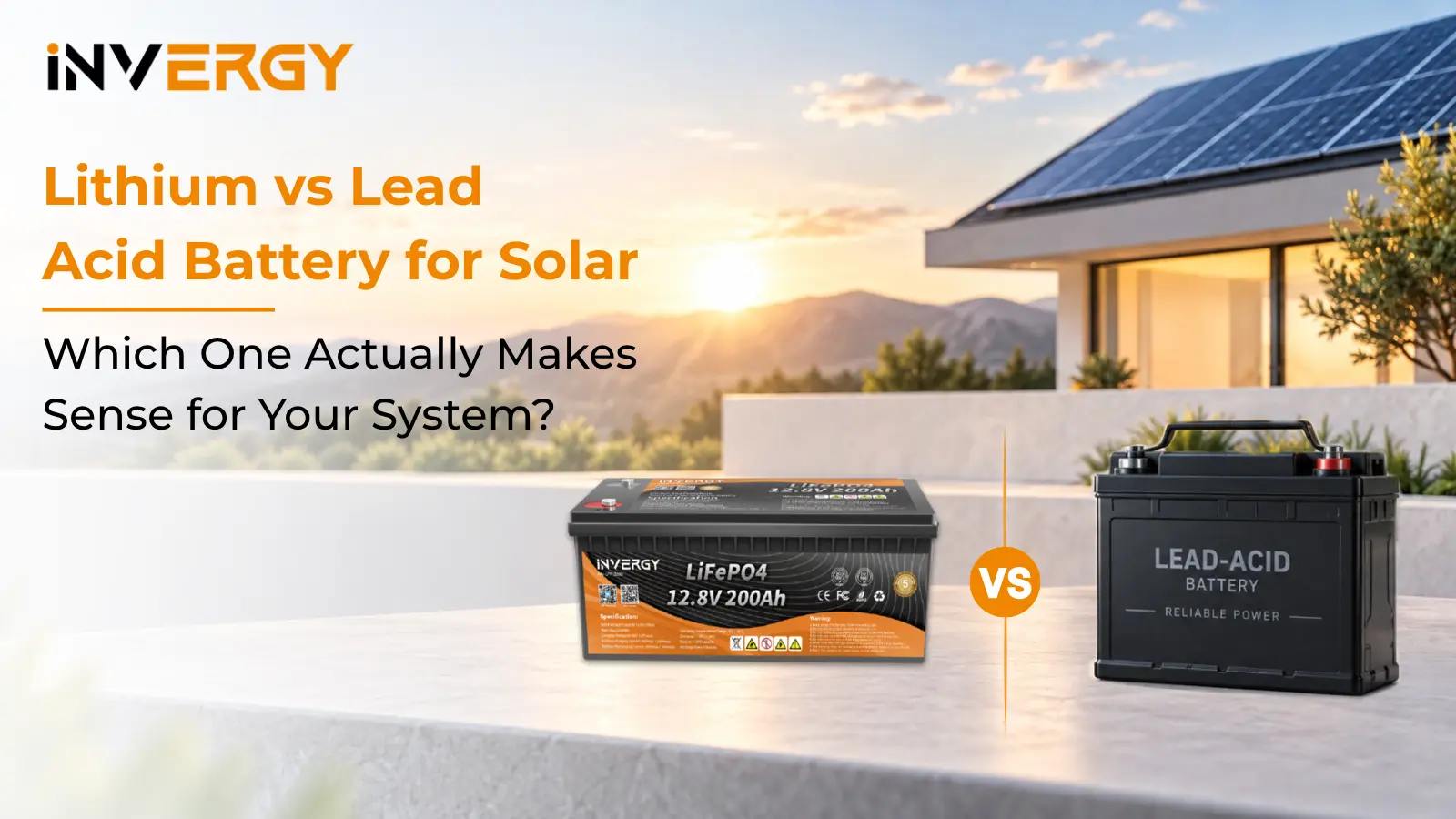
Every solar quote lists a battery brand and a number, then moves on. Ask which chemistry sits inside, lithium or lead-acid, and the conversation gets longer fast.
Search for an answer, and you will find dozens of comparison articles, and many of them quote different figures for the same thing. One site says lead-acid lasts 300 cycles, but another says 1,500. One says lithium runs at 95% efficiency, but another says 99%.
So which numbers are right, and what should actually decide your choice between lithium and lead-acid for a solar battery?
What’s actually different between a lithium and a lead-acid battery?
Lead-acid batteries store energy using lead plates and sulphuric acid, a design used in solar systems since the 1970s. They remain common in vehicles today; they are heavy, and flooded versions need periodic maintenance.
Lithium batteries used in solar systems today are almost always LiFePO4 (lithium iron phosphate). It is a specific lithium-ion chemistry chosen for stability, not for packing in the most energy per kilogram. LiFePO4 batteries are lighter, sealed, and need no water top-up.
That chemistry difference decides almost everything else here. It sets how much of the battery’s rated capacity you can actually use, and how many times you can drain and refill it. It also decides how the battery behaves as it ages.
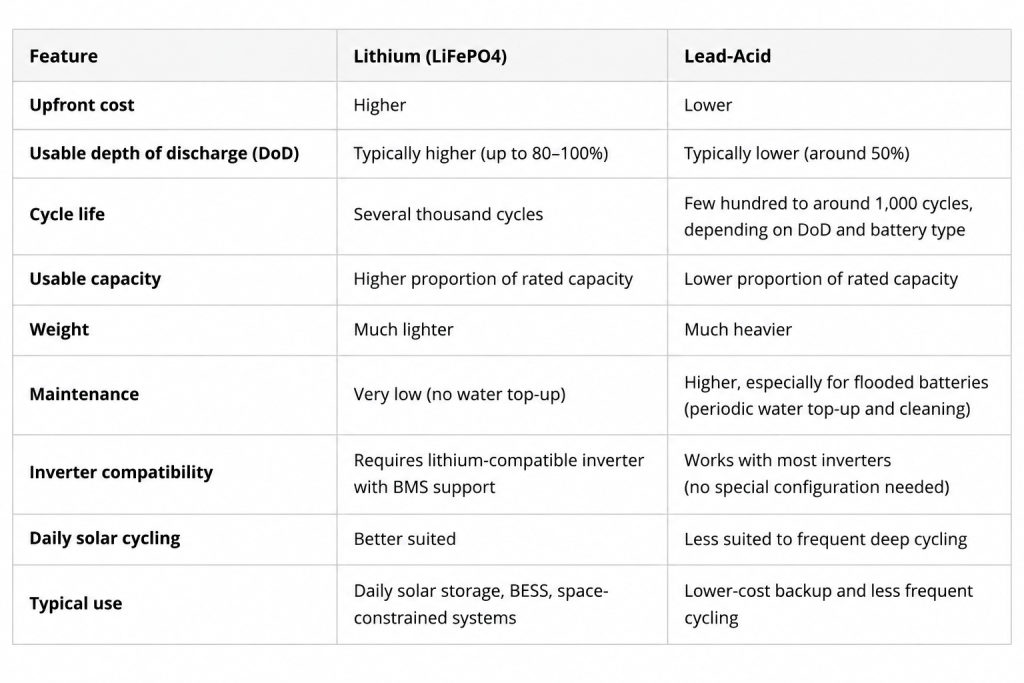
Before looking at the technical details, here is how lithium and lead-acid compare across the factors that matter most in solar storage:
Why do Cycle Life and Depth of Discharge Numbers Vary So Much Online?
Depth of discharge, or DoD, is the share of a battery’s rated capacity you can safely draw before recharging. Cycle life is how many full charge-and-discharge cycles a battery delivers before its usable capacity drops meaningfully, usually to 80% of what it started with.
Both numbers depend heavily on how deep you discharge each cycle, which is exactly why online figures disagree so much. A lead-acid battery cycled shallow, to 20 or 30% DoD, survives far more cycles than the same battery cycled to 80% DoD. Deep discharge accelerates sulphation, a process where lead sulphate crystals build up on the plates and eat into capacity.
This is why the international standard for testing renewable-energy storage batteries, IEC 61427, specifies the discharge conditions a cycle-life figure has to be tested under. A cycle-life number with no stated DoD and no stated test method is a guess dressed up as a specification, regardless of which chemistry it belongs to.
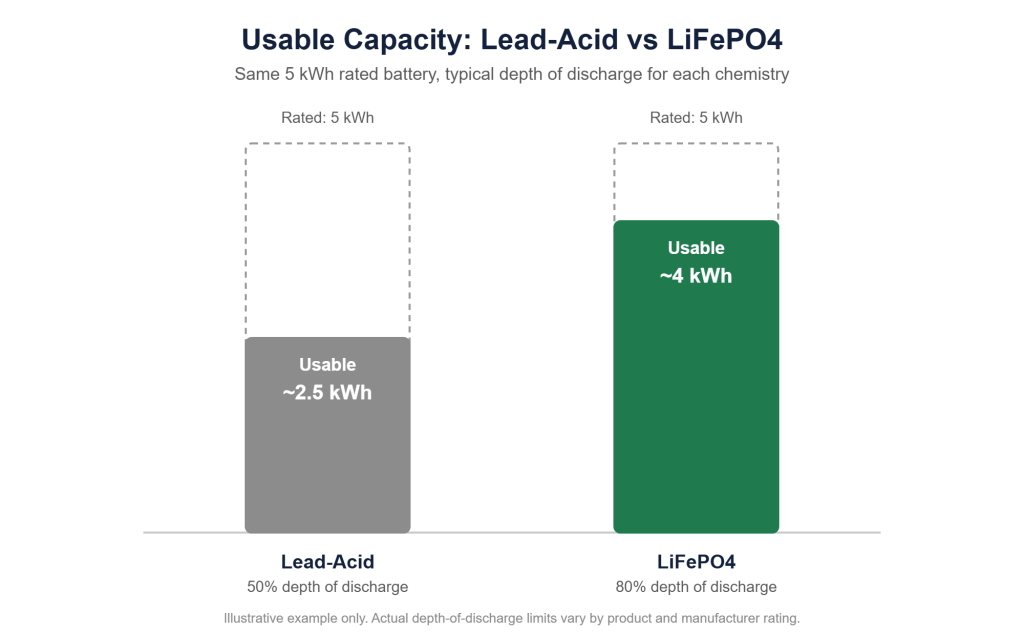
At the depths solar systems actually cycle to daily, lead-acid deep-cycle batteries typically deliver a few hundred to around a thousand cycles at 50% DoD. LiFePO4 batteries are commonly rated for several thousand cycles at 80% DoD instead. Lithium also tolerates a much deeper discharge without damage, so more of its rated capacity is usable in the first place.
What does this mean for cost over the life of your system?
Lead-acid costs less to buy. That part of every comparison online is true and not in dispute.
What changes the maths is how often the battery cycles. A solar system charges and discharges daily, a far harder duty cycle than a home inverter battery that only kicks in during outages. The lifespan gap between the two chemistries shows up faster in a solar system as a result.
Exact rupee figures move too often between suppliers and specifications to print reliably here, and installation, brand, and load all shift the number further. A fairer way to compare two real quotes is to divide price by rated capacity and by the DoD each battery is actually rated for. That gives a rough cost per usable kilowatt-hour instead of per kilowatt-hour of nameplate size, the figure that actually predicts what you will spend over ten years.
This matters more the harder a system works. A home running lights, fans, and a fridge on backup cycles differently to a small business running equipment through the working day. A business cycling its battery through a full working shift, five or six days a week, will feel the cycle-life gap sooner. That gap shows up within a few years, not a decade.
Does your solar inverter need to support lithium specifically?
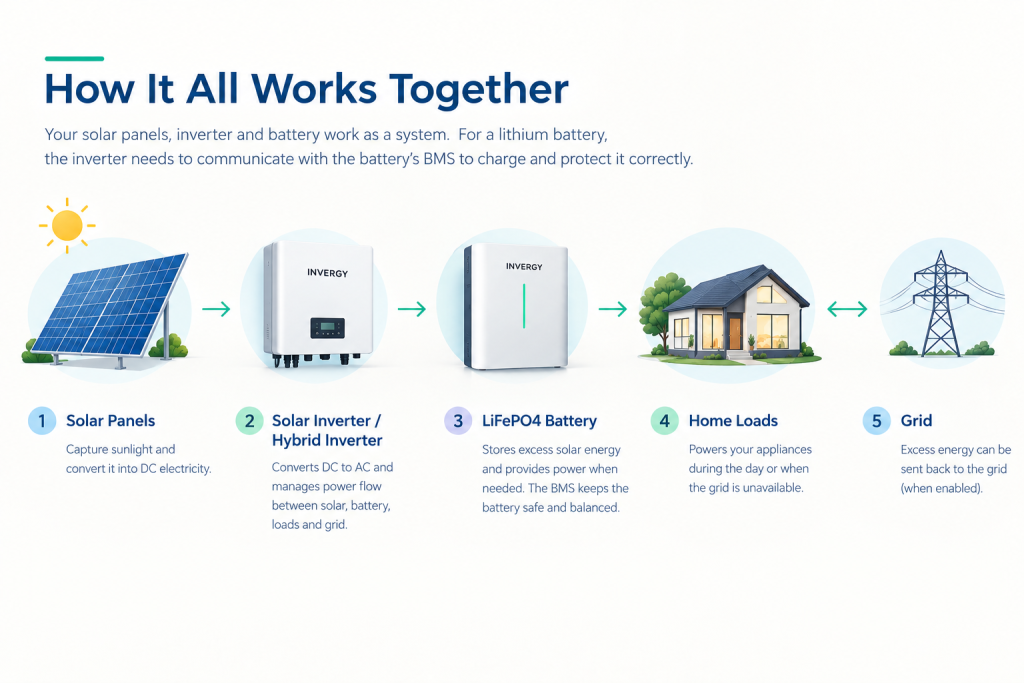
Yes, and this is the part most battery comparisons skip, because they are rarely written by anyone who also builds inverters. A lithium battery includes its own BMS, or battery management system, electronics that monitor and protect individual cells. Your inverter’s charge controller needs to communicate correctly with that BMS to charge and protect the battery.
A lead-acid bank is electrically simpler, and most inverters handle one without special configuration. Before committing to either chemistry, confirm with your inverter supplier that it is certified for the specific lithium battery you are buying, not just “lithium-compatible” in general terms.
How Does LiFePO4 Work with On-Grid, Off-Grid and Hybrid Inverters?
LiFePO4 batteries can be used with different solar inverter configurations, but the role of the battery changes depending on the system. The inverter must also support the battery’s voltage, charging requirements, and BMS communication.
LiFePO4 with On-Grid Inverters
A standard on-grid inverter primarily converts solar power for use by the loads or export to the grid. It does not automatically mean that a battery can be connected to the system. Battery storage requires an inverter or system architecture designed to manage energy storage.
LiFePO4 with Off-Grid Inverters
In an off-grid system, the battery is a core part of the setup. The inverter manages energy between the solar panels, battery, and connected loads, allowing stored energy to supply the loads when solar generation is unavailable.
LiFePO4 works well in this type of system because it can handle regular charging and discharging while providing a high usable share of its rated capacity.
LiFePO4 with Hybrid Inverters
A hybrid inverter can manage solar generation, battery storage, loads, and the grid within one system. This makes it particularly useful when LiFePO4 storage needs to work alongside both solar generation and grid power.
The exact capabilities depend on the inverter and battery combination, including whether they support the required BMS communication and operating parameters.
For a closer look at how these three inverter configurations differ, see our guides to on-grid inverters, off-grid inverters, and hybrid inverters.
Which one should you choose?
The honest answer depends on how the battery will actually be used, not on which chemistry sounds more modern.
- Daily-cycling home or business systems. If the battery charges and discharges every day, which almost all rooftop solar systems do, lithium generally delivers more value over the system’s life. Its longer cycle life and higher usable capacity are why, even at a higher purchase price.
- Occasional backup only. If the battery mainly sits idle and only discharges during outages, lead-acid’s lower upfront cost is harder to argue against, since the cycle-life gap barely comes into play.
- Tight on space or weight. A lithium battery for the same usable capacity takes up less room and weighs roughly half as much. That matters more in a shop or small home than on an open industrial rooftop.
- Commercial and industrial sites. Where a system supports continuous operations, cycle life and usable capacity tend to dominate the decision. Larger-scale battery energy storage systems for these sites are almost always built on lithium chemistries for that reason.
Is the price gap between lithium and lead-acid closing?
LiFePO4 cell prices have fallen substantially over the past few years as manufacturing has scaled up in India and globally, narrowing the upfront gap with lead-acid. Expect that gap to keep narrowing instead of reversing, though the pace depends partly on raw material costs outside any one supplier’s control.
The bottom line
Neither chemistry is universally better. A battery that cycles daily for years rewards the one with the longer cycle life. A battery that mostly sits idle rewards the one with the lower price tag instead. Match the chemistry to how the battery will actually be used, not to whichever number a comparison article printed first.
iNVERGY manufactures LiFePO4 batteries for residential solar storage and Battery Energy Storage Systems for commercial, industrial, and utility-scale applications, alongside its range of on-grid, off-grid, and hybrid inverters. If you are weighing a lithium upgrade for an existing system, our team can check compatibility against your current inverter.
Frequently asked questions
Is a lead-acid battery unsafe for solar use?
No. Lead-acid is a mature, well-understood technology and remains safe when installed and maintained correctly. Its main drawback for solar is shorter cycle life and lower usable capacity, not safety.
Can I replace a lead-acid battery with lithium on the same inverter?
Often, but not always. Confirm with your inverter manufacturer that it supports the lithium battery’s BMS communication protocol before switching. Not every inverter built for lead-acid handles lithium correctly out of the box.
How long does a lithium solar battery actually last, in years and not cycles?
That depends on how often it cycles. A battery cycling once a day and rated for several thousand cycles can reasonably be expected to last close to a decade. One cycling less often will last longer in calendar years, even at the same cycle rating.
Do lithium batteries need any maintenance?
Sealed LiFePO4 batteries need none, essentially. Flooded lead-acid batteries need periodic water top-up and terminal cleaning, and sealed VRLA (valve-regulated lead-acid) versions need less attention but are not fully maintenance-free.
Is lithium safe to install indoors?
LiFePO4 is considered the most thermally stable common lithium chemistry, and it is widely installed indoors in homes and businesses. It should still be installed by a qualified technician, following the manufacturer’s ventilation and placement guidance.

Invergy